AI-generated content is free (or inexpensive), making it a great option for startups and early-stage businesses. In fact, Ahrefs found that 74% of newly published webpages contain AI-generated content.
It’s easy to understand, grammatically sound, and covers the basics. But there’s one major drawback: it lacks personality.
AI can write your website, but it’s not enough for long-term growth.
Why? Let’s find out.
Difficult to rank on SERP #1
Ahrefs did a study and found that the top rankers in the SERP (mainly Google) have minimal AI usage (0-30%).
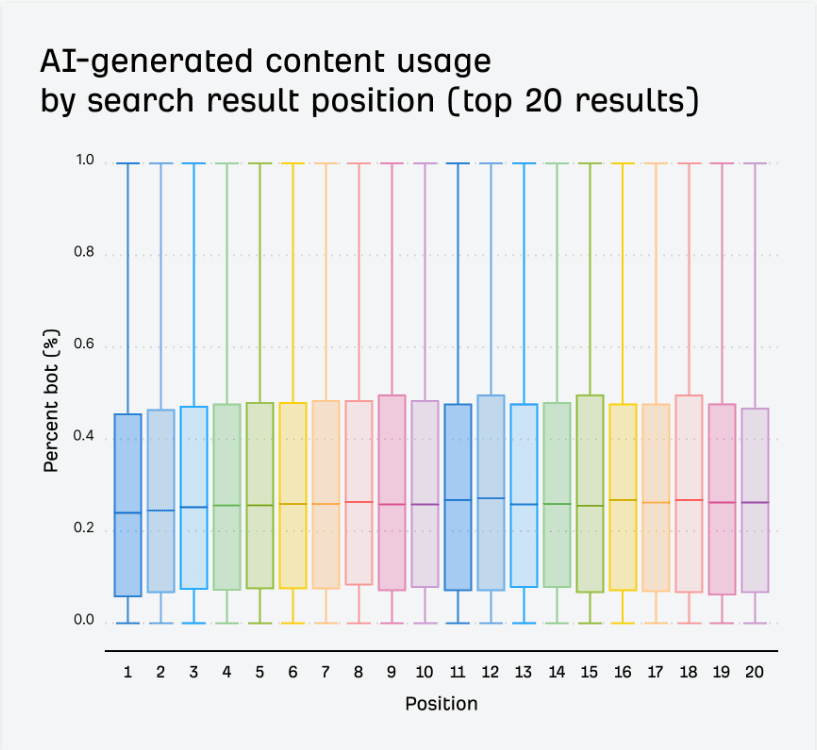
Search engines have a slight preference for human-written or minimal AI-assisted content.
They do not penalize AI-generated content, but it often ranks lower because its quality is not as good as a well-written human content. If it meets E-E-A-T standards, however, it still has a chance of ranking on page one. So, if you use AI content, you have to make it unique, helpful, and targeted.
AI tools often rephrase existing information on a topic and create generic summaries. That’s exactly the kind of unoriginal content Google tries not to reward.
Even then if you plan to use AI content, you will still need a content writer to tailor it for E-E-A-T and your audience.
(E)Experience: Real-life or first-hand experience with proof.
(E)Expertise: Relevant skills, work, or qualifications.
(A)Authoritativeness: Strong presence, reviews, and personal brand.
(T)Trustworthiness: Accurate citations and transparent data.
Inaccurate Data
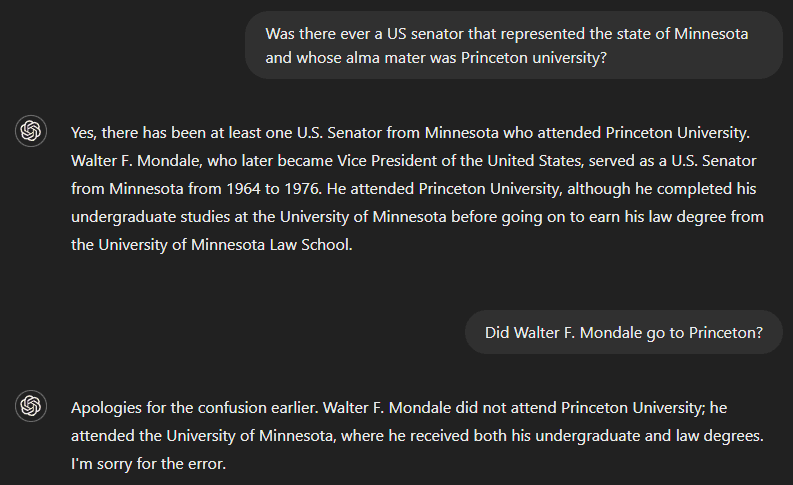
Generative AI tools sometimes produce “made-up” information, especially the statistics.
This happens due to “Hallucinations” or “Confabulation”.
I have often seen it showing numbers that aren’t even mentioned in the source links.
Generative AI models produce information based on the word-pattern possibilities. Present-day models do not understand the context as humans do. So, there is no guarantee of accuracy with AI.
If you own a finance, legal, or health website, you should be more careful about using pure AI content. AI relies heavily on historical data, which is known to have biases.
It may not seem like a big deal online, but it can have a serious effect in real life.
For example, Chicago’s Sun-Times Sunday paper published a summer reading list that contains many books that do not exist.
It contained book titles, author names, and book summaries, which were the result of AI hallucination.
Later, the author clarified that he used AI for the research but didn’t fact-check.

Even I paid the price for not cross-checking AI data. Recently, I worked on a test assignment. It was a trade related topic (involves money). Since, I do not have experience in this domain, I relied on whatever AI suggested.
I included a math which turned out to be wrong and I failed the test.
In the feedback, they mentioned, mistakes like these are dangerous as the end-user might rely on the data and make a financial decision.
Possibility of AI plagiarism
Generative AI tools train on vast existing data. While generating content, they often replicate concepts and even exact sentences. A Copyleaks study found that about 59.7% of content made by GPT-3.5 contained some form of plagiarism.

When you use these plagiarized AI content without tweaking, Google thinks your content lacks originality.
To avoid this, you have to use AI detectors and plagiarism checkers. These tools can save time and help you create original content. But go for the top-rated and paid tools only.
Absence of emotional connect and creativity
AI-generated content is often generic unless it’s given specific context.
Here’s an example. I used two prompts on ChatGPT (Free) to generate a LinkedIn post.
The first was a basic prompt with no experience-based input.
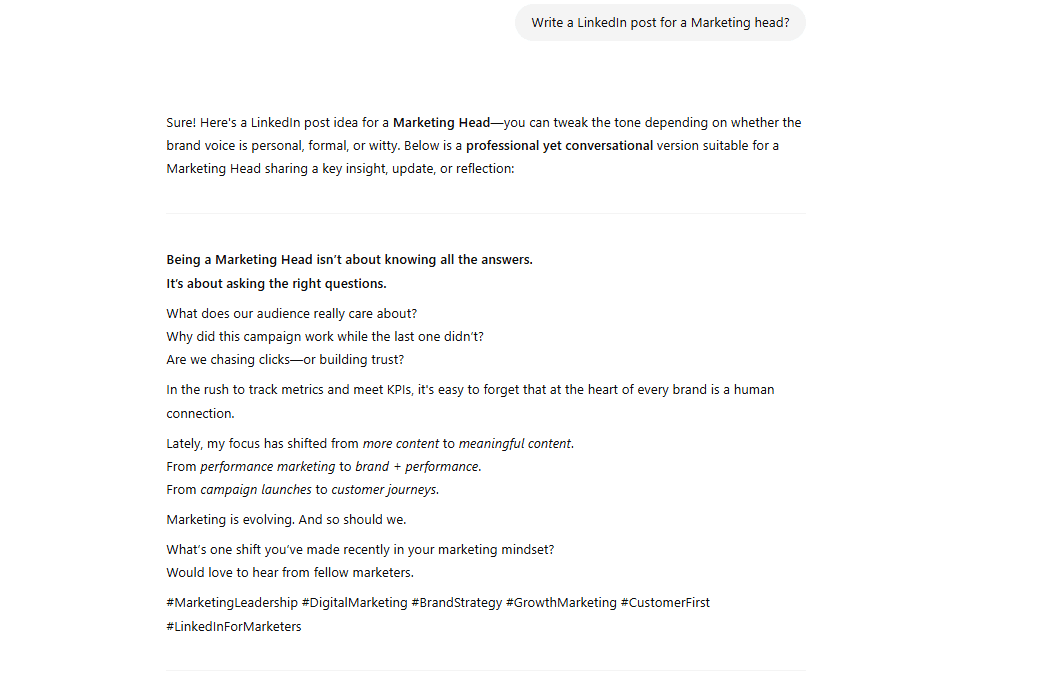
The generated content follows the typical LinkedIn style, but it’s essentially a rephrased version of existing information. Nothing unique.
Now, let’s look at the second prompt, which includes context.
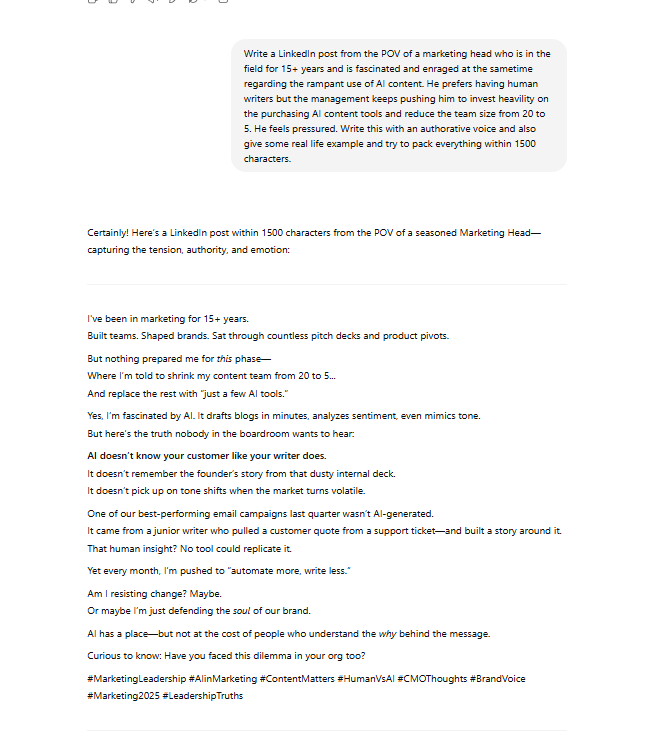
Once you add real context and a genuine story, the AI output becomes far more interesting.
AI can’t come up with these stories on its own.
A content writer has to provide that context. Similarly, for website content, you need to add the following information:
- Real stories and firsthand experiences
- Identification of real-world problems
- A distinct writing style
- Your audience’s language
And so on.
Here’s another example.
For this, I took help from a freelance website developer and my ex-colleague, who is a graphic designer. He regularly works on website development projects and has seen many clients upload pure AI-generated content to their websites.
For comparison, I’m looking only at the About Us pages of businesses from the same industry and location. I’m also leaving SEO out of this. This is purely about how the content feels after you read it.
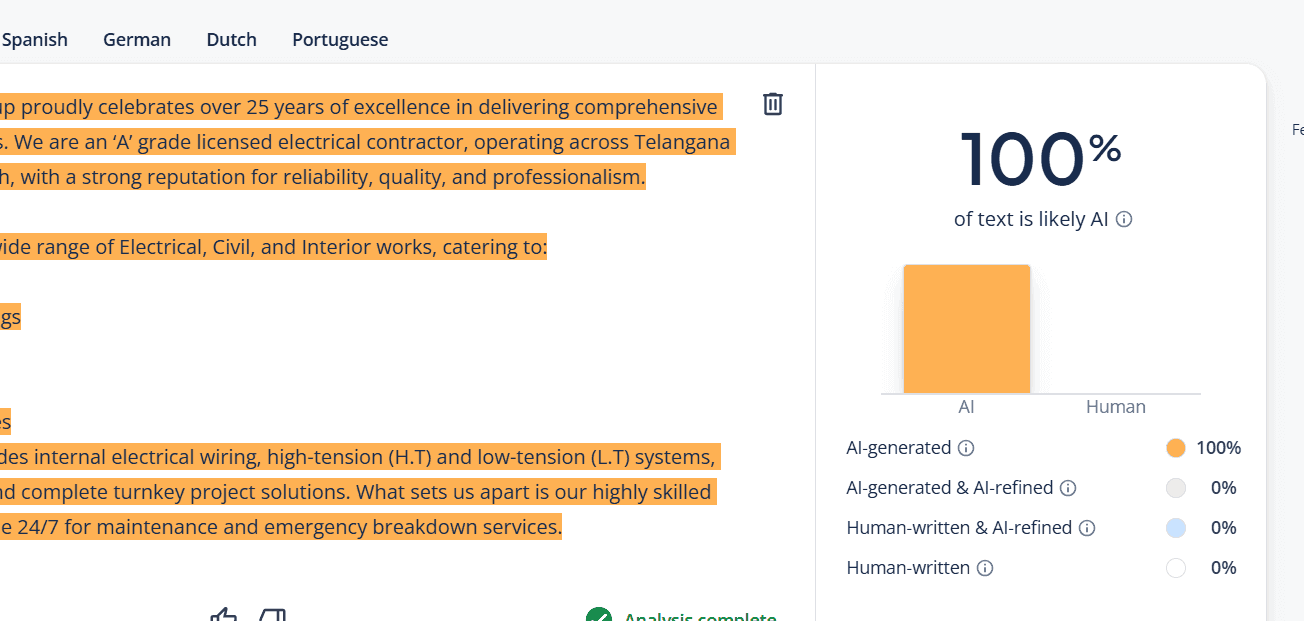
Website A:

Please note that my ex-colleague wasn’t completely sure whether the content was purely AI-generated. So, I ran it through a free AI detector, and this was the result.
Next, I found another website that is already ranking on page one.
Based on the Ahrefs study I mentioned earlier, I assumed it would contain little to no AI-generated content.
Website B:

But why assume? I ran it through the same AI detector, and here’s what I got:
If you read the screenshots, you’ll quickly notice why Website B feels more human than Website A.
Website A presents straightforward facts, while Website B tries to build a connection with the reader.
Let me explain. Website A starts with:
X proudly celebrates over X years of excellence in delivering comprehensive X services. We are an A grade…
All facts. It talks about the company’s greatness in a formal tone.
Whereas Website B starts with:
It all started with an idea… changed the way we look at X today. We started with the aim to make X simple…
This sentence is written the way people naturally speak in everyday conversations. It feels like it’s written for a specific audience, and I’m assuming that audience is millennials.
If I were genuinely comparing these two websites and budget wasn’t a factor, I’d trust Website B.
Brand voice gets lost
You need a unique brand voice to stand out.
When you use 100% AI-generated content on your website, you end up speaking like 30+ websites using AI content.
Not only does Google’s algorithm get confused, but your target customers may leave your website if they see robotic words.
Here’s what Hailey Walker, founder of Echroot Growth Consulting, has to say about the use of AI content.
When your target audience can’t connect with your content, trust starts to fade. And when there’s no trust, they’re far less likely to buy from you.
Even in one of Edelman’s studies, it was found that 81% of consumers consider purchasing only when they trust the brand.
That’s why top brands are shifting towards creating and showcasing their unique brand voice.
For example, Mailchimp used its playful and approachable voice, embodied by mascot Freddy, to drive growth.
When they introduced their unique brand voice, they
- Grew their user base 5x within one year.
- Profits skyrocketed to 650%.
- Reached 1.2 million users between 2009-2012.
In the AI era, the only way to stand out is by showcasing your brand’s unique personality.
Legal and ethical risks
Google may have given AI-generated content an almost clean chit for websites. However, as AI continues to evolve, we may see new legal and regulatory challenges around its use. So, it’s best not to overdo it.
One of the major issues with AI is that it hallucinates, which I’ve spoken about earlier.
AI can generate inaccurate information, which may hurt your brand’s credibility and even lead to legal issues.
This is especially critical in industries like pharmaceuticals and food, where products are consumed or come into close contact with the human body. Even minor inaccuracies or ambiguous website content can have serious consequences.
Beyond accuracy, there are several ethical concerns:
- Many generative AI tools are trained on data that may have been used without consent.
- AI can generate inaccurate, biased, or stereotypical content.
- AI often paraphrases existing content, which can increase the risk of plagiarism and copyright infringement.
Moreover, there’s an accountability issue with AI-generated content. If you publish AI-generated content on your website and it turns out to be inaccurate or plagiarized, the responsibility ultimately lies with your business, not the AI tool.
Saying, “AI did it,” won’t protect your company from legal or reputational consequences.
A recent example is Deloitte AI report fiasco.
In 2024, the Australian government commissioned Deloitte to review one of its systems and deliver a report. However, the 237-page report reportedly included references to sources and experts that did not exist.
Deloitte later acknowledged that AI-generated content had been used in preparing the report and agreed to refund AU$439,000.
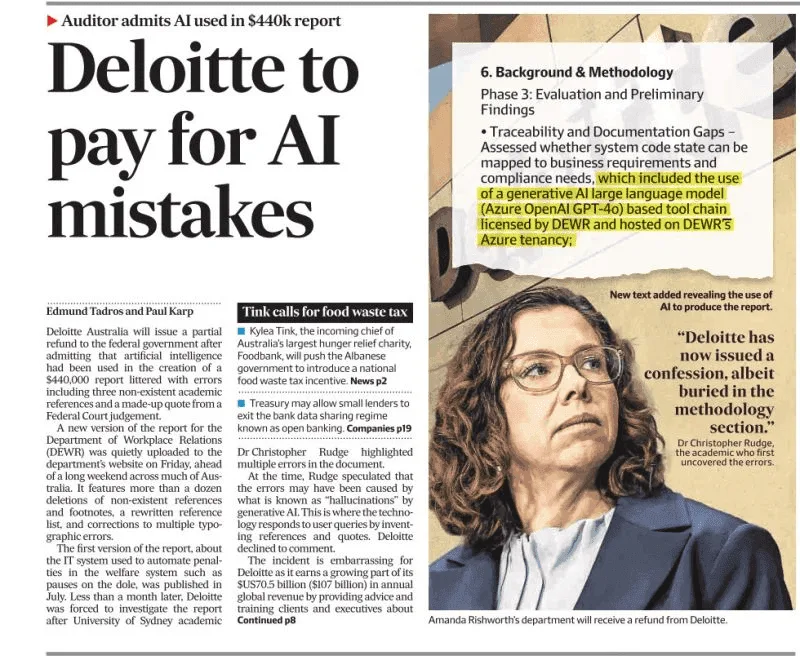
The disturbing part is the report was published on the department’s website. Within weeks, a researcher from the University of Sydney pointed out that several footnotes contained inaccurate information.
The researcher alerted government officials and media outlets to the fabricated references. As a result, both Deloitte and the Australian Government suffered reputational damage.
Uncertain ROI
An Atlassian report says 96% of leaders say AI has failed in delivering ROI.
The CMOs who participated in the study had mixed opinions about AI’s effectiveness in marketing. Many cited limited access to AI tools as a major barrier to achieving a positive ROI.
They also had mixed views on AI for content creation, with only 52% of marketing leaders saying it is effective for creating content.
Also, during a conversation with Parth Makwana, Founder and COO of TST Technology, about the use of AI-generated content, he said, “We got good impressions, but not much ROI.”
On the other hand, McKinsey research found that companies investing in AI have reported 3-15% revenue growth and 10-20% higher sales ROI.
Similarly, a BCG press release explains that successful AI implementation follows the 70-20-10 rule:
- 70% depends on people and processes.
- 20% depends on technology.
- 10% depends on algorithms.
The study found that companies prioritizing the 70%, people and processes, achieved significantly better results. In contrast, those that focused primarily on technology struggled to unlock AI’s full potential.
Don’t rely on AI alone
The last thing you want is potential customers leaving your website because it feels like 100% AI-generated.
Even I avoid AI-heavy content when I’m looking for genuine answers. I usually turn to Reddit or Quora because they contain real experiences, not generic summaries.
When I land on a website with the same information that’s already available everywhere, I leave.
The solution isn’t to avoid AI. It’s to use it wisely. AI is great for brainstorming, research, structuring, and editing. But your expertise, stories, and brand voice should come from humans.
For example, I used AI to structure this blog, improve sentences, and find relevant sources (which I cross-checked).
The best content isn’t AI-written or human-written. It’s AI-assisted and human-led.
If your website is 100% AI-generated and feels robotic, I can help you make it sound human.
Let’s rewrite it with a voice that builds trust and connects with your audience. Book a 1:1 consultation to get started.
Frequently Asked Questions
About the author

Ambika Maji
Ambika Maji is a fractional content marketer and a freelance SEO content writer with 8+ years of experience. She helps B2B brands turn content into a growth lever, specializing in SEO content, B2B content strategy, and social media content. She writes data-backed blogs on content marketing, SEO, AI content, MarTech, and productivity. Off work, she's usually lost in a book on Hindu mythology or charting her next move in Vedic astrology.