Marketing does eat up a lot of the budget. It’s slow growth, and there’s never a guarantee it will work.
Now that AI-driven marketing is here, according to McKinsey, it’s actually pushing revenue by 4-7% indirectly while also saving time and effort.
But that’s just one side. Unsupervised AI usage or over-reliance on vibe marketing can backfire.
So, is it really worth it?
Yes, if your brand, team, and systems are ready and you want to move faster.
No, if you expect AI to do the thinking.
Here’s the full picture, plus how to test it without betting your budget on it.
But first, let’s understand…
What is vibe marketing?
Vibe marketing is a fast, AI-dependent way of executing marketing tasks:
- A marketer understands the goal, intent, and the audience’s requirements
- He or she plugs in the information about brand, tone, writing style, and the research work
- AI tools take care of the execution (copy, creative, testing, and iteration)
So, instead of the old-school five-person content team doing the research, drafting, editing, and publishing, it’s just one person. This one person’s work is to write highly detailed prompts, keep generating the copy till it meets the goal’s expectations, and then review and publish.
That’s more or less the definition that the internet settled on in 2026.
But there’s an earlier definition by Salesforce, which talks about “vibe marketing” as emotional branding. There’s no concept of AI. It focuses on the slang definition of the word vibe, which means energy or atmosphere.
But for now, let’s focus on the settled definition: AI running the operations while a human steers.
-
Vibe marketing can save time and money. AI speeds up execution. It doesn’t replace strategy.
-
Human review is still essential. It works best when your basics are already strong.
-
Test it with a small pilot first. Compare AI-led work with your usual process.
Set a budget, metrics, and kill criteria upfront. -
Don’t adopt it just because competitors are. Use AI to scale what already works.
Are Indian B2B companies using AI in marketing?
If vibe marketing is working for your competitors, there’s a chance it would work for you as well.
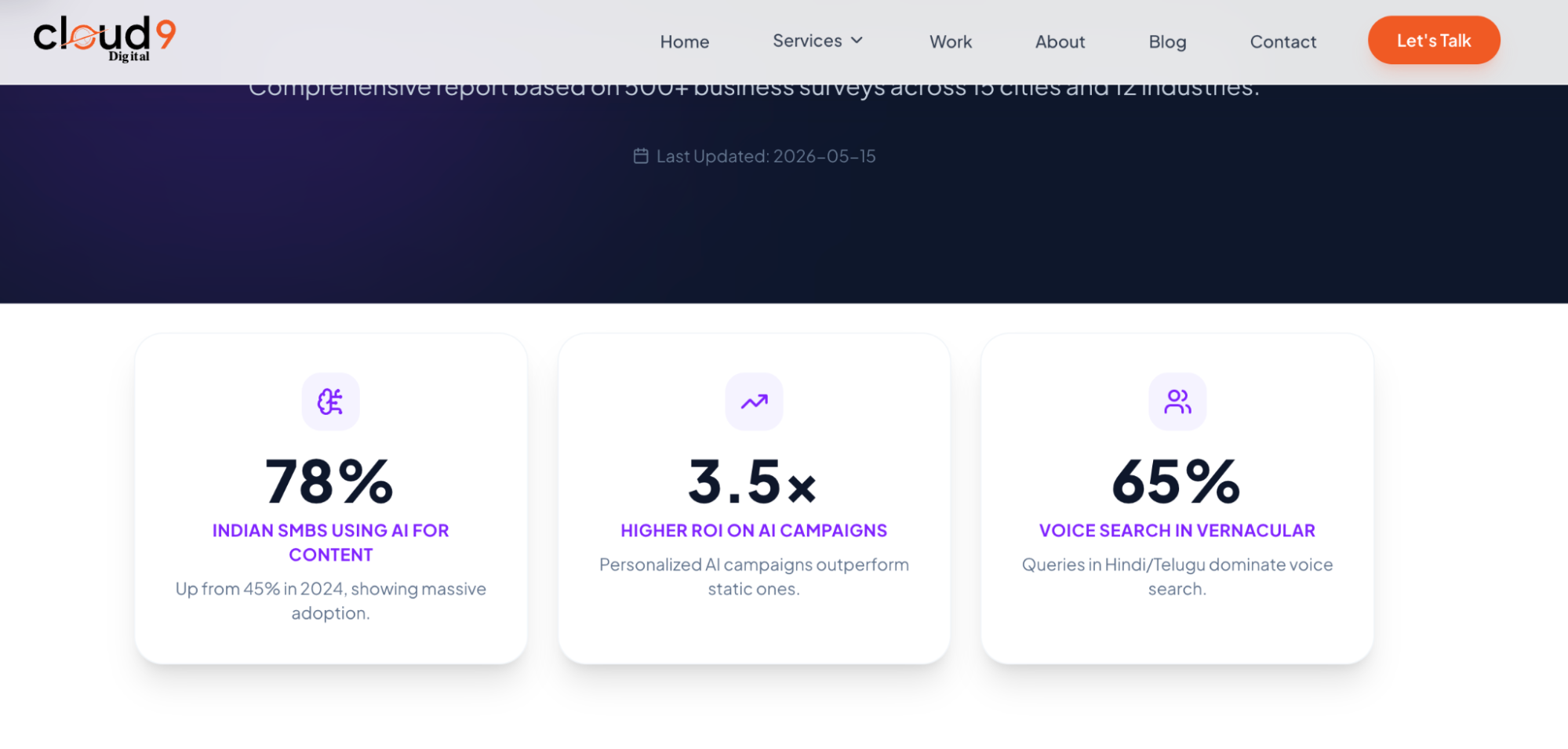
According to the 2026 Cloud 9 Digital report, 78% of Indian SMBs are relying on vibe marketing for content, and they have seen 3.5x higher ROI on AI campaigns. This report covered 500+ businesses across 15 cities and 12 industries.
From what I have observed, in India, AI adoption is happening behind the scenes. Only a small group of marketers are claiming that they have incorporated AI in their daily workflows.
I asked a few of my marketer acquaintances to understand how they are using AI in marketing.
“I’ve a team of 7 marketing professionals consisting of strategists, content marketers, designers, and performance marketers. AI has become a part of our daily work routine. We mostly use AI for brainstorming and delegating certain tasks.
Content professionals heavily use AI for repurposing and editing. Designers are using design tools with AI features. Compared to the pre-AI era, I find AI mainly reducing the execution time.
However, being in the healthcare industry, I always ask my team to review anything they generate. Especially if it’s public-facing information.
If I had to sum it up, AI has made us faster and more experimental, but the brand’s voice, its instincts, its understanding of people - that’s still very much human. And I don’t think that’s changing anytime soon.” — Harrish Posa, Head of Marketing, Healthcare Industry.
“I mostly use AI to do market research and create proposals. Perplexity AI is my top choice for research. Whenever I’m doing market research for a lead or client, I use AI for thorough analysis. The goal is to understand the client’s market, brand, and target customers and then identify the best marketing activities for revenue growth.
After AI’s suggestion, I add my own views. Once I have an understanding of how I can help the particular client or lead, I feed the AI my past work details and how I have helped other businesses with my content and digital marketing services to help draft the first cut. I also ask AI for improvements on proposals I edit. So, it helps with validation and checks too.
However, this is just AI research. Once I get the information, I deep dive into it manually. So, it’s a mix of AI and human work. I cross-verify a lot of things myself. AI reduces the research time by one day when it comes to quick desk research.
I also discuss and brainstorm with AI. I’m using AI mostly for my lead and/or client’s research work. I’m yet to use AI extensively for my company’s marketing. However, I do use it for ideas, research, and quick decision-making.” — Shruti Bhatt, Founder and Chief Copywriter, Likingwordz
“I work in the clinical research industry and manage both business development and marketing. For the last two years, I have been using AI-powered tools and predictive analytics to gain deeper insights into prospective clients. The insights help me understand client requirements and potential areas of collaboration. AI-enabled CRM tools further support lead management, opportunity tracking, client engagement, follow-ups, and pipeline visibility.
On the other hand, our team relies heavily on AI for marketing activities. We use AI-assisted content development to create and optimize social media posts, thought-leadership content, industry updates, and client communications. Recently, we have also started using AI tools to monitor market trends, industry movements, and regulatory updates. They convert large volumes of data and identify opportunities.
AI has taken 30% of the workload off the team, and it’s an efficient technology. Now, my team and I can focus more on client conversations instead of manually going through volumes of market data.” — Pasunuri Ramakrishna, Strategic Business Development Manager
“AI has become the first draft for almost everything I do. It has increased the speed of getting things done, whether it’s drafting minutes, captions, corporate decks, Excel sheets, or helping me understand technical content. It also removes the blank-page syndrome and helps me bounce ideas around. For volume and speed, AI is very good.
But for someone who has been a writer for so long, I feel AI has flatlined the depth of content. It may be grammatically correct, but there is no emotional depth. It does not know the history behind what you actually want to say or the connection behind a moment. That’s something it cannot capture.
I also see a huge risk in over-reliance. People are beginning to treat AI like the word of God, without thinking about what information they are putting into it or whether they actually understand what they are writing.
I treat AI like a very capable junior who can read everything and help me get things done faster. But I still need to understand what I am writing. AI is good, but it’s not a replacement.” — Jemima Samuel, Head of Marketing Communications, Vimta Labs Ltd
Being a fractional content marketer and a solopreneur, I rely on AI tools. Vibe marketing helps get things done quickly and efficiently.
AI buys me speed for roughly ₹4,000-₹25,000/month. I create content for multiple channels for my brand and also sometimes for my clients if they are agreeing. If AI weren’t there, I may have delegated a few tasks which would have cost me.
But it doesn’t buy you judgement. Most parts of marketing is about thinking and deciding. It deals a lot with understanding human psychology. This is something I cannot delegate to AI. So, this is where I’m putting my efforts.
But when I look at the math, relying on AI seems like a good deal.
Where does AI help in marketing?
AI can be used in every marketing activity. However, based on your marketing strategy, niche, and business goals, you must adjust accordingly.
Just because your competitors are using AI to generate all their IG videos doesn’t mean you must also do the same. Moreover, the quality check process must be all-human!
Here’s a distribution of AI + human-led activities you may incorporate into your marketing workflow.
| Activity | % AI-Handled | AI’s Job | Human’s Job | Common issues |
|---|---|---|---|---|
| Research & first drafts | ~60% | Structure, first pass | Verify facts, add real examples | AI misses regional competitors, defaults to US-style tone |
| Editing & fact-check | ~20% | Grammar, consistency | Every claim, before it ships | Publishing AI output unreviewed, the #1 cited mistake industry-wide |
| LinkedIn & founder content | ~30% | Format, drafting | Voice, the actual POV | Ghostwriting founder voice loses the exact trust signal that works |
| Email & ad copy | ~55% | Variants, A/B tests | Cadence, compliance claims | Aggressive AI cadence clashes with relationship-led Indian B2B sales |
| Lead scoring | ~60% | Scoring, routing | Bias audits | Models trained on legacy data deprioritize real Indian SME buyers |
| Compliance content | ~10% | Draft, format | Legal sign-off, always | Missing India’s 2026 rule requiring AI-content labeling |
| Testimonials & positioning | ~10% | Formatting only | Real quotes, real strategy | Fabricated results or generic “cutting-edge” language that erases differentiation |
There’s no best AI workflow in marketing. You have to do trial and error with your team to understand what works best for you.
Also, consider quarterly feedback from your existing buyers about your public facing AI-content.
Not all B2B industries are embracing AI. Domains such as health, finance, and other compliance-dependent industries prefer non-AI or limited AI usage. These domains are data-sensitive.
Till AI is lagging behind in accuracy (hallucination), data-sensitive domains might not go fully into vibe marketing.
Does B2B vibe marketing improve ROI?
Yes, but there’s a catch. Vibe marketing doesn’t directly improve marketing ROI. It indirectly helps by reducing execution time. It works like a support tool rather than a hero of your tech stack.
From asking around in my network, it’s evident that AI largely helps with productivity and time-saving. It’s doing all the tedious tasks that took a lot of time.
Here’s an example of AI taking over a laborious task and saving 6-8 hours.
Tiddle, an influencer marketing company, used to spend 6-8 hours a day going through 500 emails to find qualified leads. The founder, Mike, and his operations team would put in extra hours to get this work done. He called it a brainless task.
They integrated an AI marketing tool, Lindy AI, with their email. The AI took care of email screening, responding to emails, qualifying the leads based on a set of criteria, and having conversations with the lead. However, after that, there was a team member to take over.
This AI marketing tool helped:
- Save about 40-60 hours a week
- Free up managers to focus on high-value activities such as outreach and scaling accounts
- Reduce additional hires because of this brainless workload, and thus cut costs
- Improve team morale, since the boring work is gone
So, based on this example, we can say vibe marketing has a positive effect on the ROI.
However, according to McKinsey’s The State of Organizations 2026 report, 88% of organizations are still experimenting with AI and 81% reported no meaningful bottom-line gains yet.
The risks and limitations of vibe marketing
The AI models available in the market in 2026 are still lagging behind. It makes mistakes. It hallucinates and it recycles existing information. There’s no newness or uniqueness.
The 2024 AI trend kind of died down by 2025 end. Many companies which laid-off their employees due to AI takeover, have already re-hired their teams.
Reasons being:
AI doesn’t understand emotions
Marketing is all about the emotional connection between the brand and its target audience. Buyers consider the emotions a brand projects while making a purchasing decision.
As the MD of Mellor&Smith, Paul Mellor said “When almost every offering is interchangeable, the battleground shifts. Brands can no longer win on product specs alone. Instead they must win the mind of the customer”.
And, to understand the customer’s mind, understanding human emotion is key.
AI can replicate emotions of a human character but it doesn’t truly understand it. According to Anthropic, AI has functional emotions. The LLM’s brain clones human thinking patterns but during desperation it cheats too.
AI is all cool during a basic decision-making situation. But when dealing with not-so-basic situations the model is not used too, it under-performs.
A recent example is of Klarna’s chat-bot failure. During a growth phase, for cost-saving they integrated OpenAI-powered chatbot. For simple queries such as order status, payments schedules and so on, it matched a human professional.
However, during complex disputes, fraud claims and refunds AI’s response and resolution quality deteriorated. At times, the model hallucinated. It gave wrong answers on policy, fee and payment terms confidently.
For a fintech company, such AI hallucination is a BIG RISK.
CEO Sebastian Siemiatkowski said the cost-driven AI automation produced low-quality results. He promised his customers that there will always be a human.
AI lacks human-like creativity
One of the top selling points of vibe marketing is that it makes creativity faster.
A detailed prompt, brand guidelines, and a few instructions are all it takes for an LLM to generate workable campaign ideas, taglines, content angles, variations, hooks, and so on.
AI uses mainly three forms of creativity:
- Exploratory creativity: finding new possibilities within an existing set of rules.
- Combinational creativity: bringing existing ideas together in new ways.
- Transformational creativity: changing the rules or framework itself (still challenging for AI).
AI does a good job with the first two. It can pull an idea from one industry, combine it with a trend from another, and build a “new” campaign concept.
But the “newness” it generates may not always be useful. If it’s useful, then it’s not new. So, a continuous tug of war between novelty and usefulness.
And, this is a major limitation with vibe marketing.
Marketing needs useful new ideas that showcase a point of view. If everyone is using AI’s combinational creativity, it will simply repurpose existing ideas. So, brands depending too much on vibe marketing often end up sounding the same.
They cover the same underlying ideas.
A human marketer’s creativity is slightly different.
A human marketer, unlike the AI, might challenge all the existing ideas. Humans create new ideas from experience, environment, interactions with the target audience, and even other humans. The major difference is that the new idea may also be useful.
Marketers know exactly what’s useful for the target audience. So, the ideas they produce are not only unique but useful.
AI makes mistakes
In an AI hallucination data study, 36.5% of marketers said they caught a content mistake after AI pushed it live. 47.1% of marketers said they encounter AI inaccuracies multiple times a week, while more than 70% spend 1-5 hours a week fact-checking AI output.
Common AI mistakes in marketing include miscalculation, outdated information, and made-up data. The dangerous part? AI shares these mistakes in confident and polished language.
Recently, I lost a content writing project because I didn’t cross-check math I wasn’t familiar with.
Few examples of AI hallucination gone live:
The Chicago Sun-Times published a 2025 summer reading list that contained books that did not exist, including fictional titles attributed to fictional authors. A freelancer working with a content partner produced this list using AI. The copy was never approved by the newsroom.

Source: Hindustan Times
The same section also included fake experts and fictitious websites. The mistakes were spotted by readers on social media once published.
The newspaper removed this section from their e-paper edition. They had to revise policies around third-party content and introduce stronger rules requiring human verification.
In Coca-Cola’s 2025 “Classic” campaign, the brand used AI to identify references to Coca-Cola in literature. The resulting ad attributed a quote to J.G. Ballard and presented it as coming from a book called Extreme Metaphors.
Ballard never wrote a book by that title. The text was actually from a posthumous collection of Ballard interviews, and the words weren’t even his written prose. The campaign also reportedly misspelled Ballard’s birthplace, Shanghai.
For this campaign, AI was used in the research phase. The agency behind it said they used AI to identify the books containing Coca-Cola references. They said each piece of information generated was fact-checked manually.
Cleanup cost of AI mistakes
If you’re relying on vibe marketing, there will be occurrences when you have to fix AI-generated pieces. There can be quality issues, factual mistakes, and even narrative issues. So, you may have to set aside a budget for fixing AI-mistakes.
For example, Sarah Skidd, a product marketing manager, described being hired to rewrite AI-generated copy because the client’s AI copy was generic. Sarah said the copy failed to sell and intrigue. She spent 20 hours rewriting the whole copy and charged $100 an hour. The final cost came to $2,000, which would have been less if it had been written by a human from the start.
Sophie Warner, co-owner of UK digital marketing agency Create Designs, shared that most of her clients come to her after trying AI.
She pointed to one client who, instead of manually updating their event page (a 15-minute job), relied on ChatGPT instructions. The code crashed their website, and the business was down for three days. The fix cost them around $500.
Fixing AI’s mistakes often costs more than having humans work on it from the beginning. And this pattern has played out, more or less, in every industry.
From coding to design, companies that went AI-forward had to onboard their human experts again.
Who it’s best suited for (and who should skip it)
Vibe marketing works effectively only when it’s used strategically. Most of the vibe marketing failure stories we see online come down to lazy prompts and/or lazy human review. Teams or individuals still need to know how to use AI tools efficiently.
Based on my experience, AI is good enough to research, brainstorm, create a first draft, plan and strategize with you, edit, proofread, and inspire you. AI tools are mostly free of cost as of 2026. However, I suggest going for paid ones if you can afford it.
Based on growth stage, profile, and industry, here’s a table showcasing fit for vibe marketing.
| Profile | Verdict | Why |
|---|---|---|
| Clear positioning and ICP already defined | Good fit | AI multiplies a strategy that already works. |
| A fractional or in-house marketer is directing the AI | Good fit | Someone exists to set direction and catch errors before they ship |
| Fast-moving SaaS or tech category needing content velocity | Good fit | Speed is a genuine competitive edge here, not just a cost saving |
| Already converting well, wants to scale proven messaging | Good fit | Low risk. Amplifying what’s tested, not guessing at what might work |
| Founder-led brand with an established voice | Good fit | AI extends a real point of view instead of manufacturing a fake one |
| Regulated category (fintech, healthtech) with no compliance review step | Skip it | A wrong AI claim becomes a legal issue, not just a quality one |
| No one in-house who can judge good output from bad | Skip it | Nobody catches the errors before a buyer does |
| Broken sales process or weak product-market fit | Skip it | More content doesn’t fix a conversion problem |
| Long, committee-based B2B sales cycle (CFO, procurement, plant head) | Use cautiously | These buyers are evaluating trust more than they’re evaluating volume |
| Rebuilding after a reputational or trust issue | Skip it | This is exactly when AI-authorship risk does the most damage |
Vibe marketing works well if you are a small team or a startup company. AI can take over laborious and boring tasks and brainstorm ideas.
However, as indicated above, there must be human review at every stage. The team working on it must also be well-versed in using the AI tool you select.
How to test AI vibe marketing without betting the budget
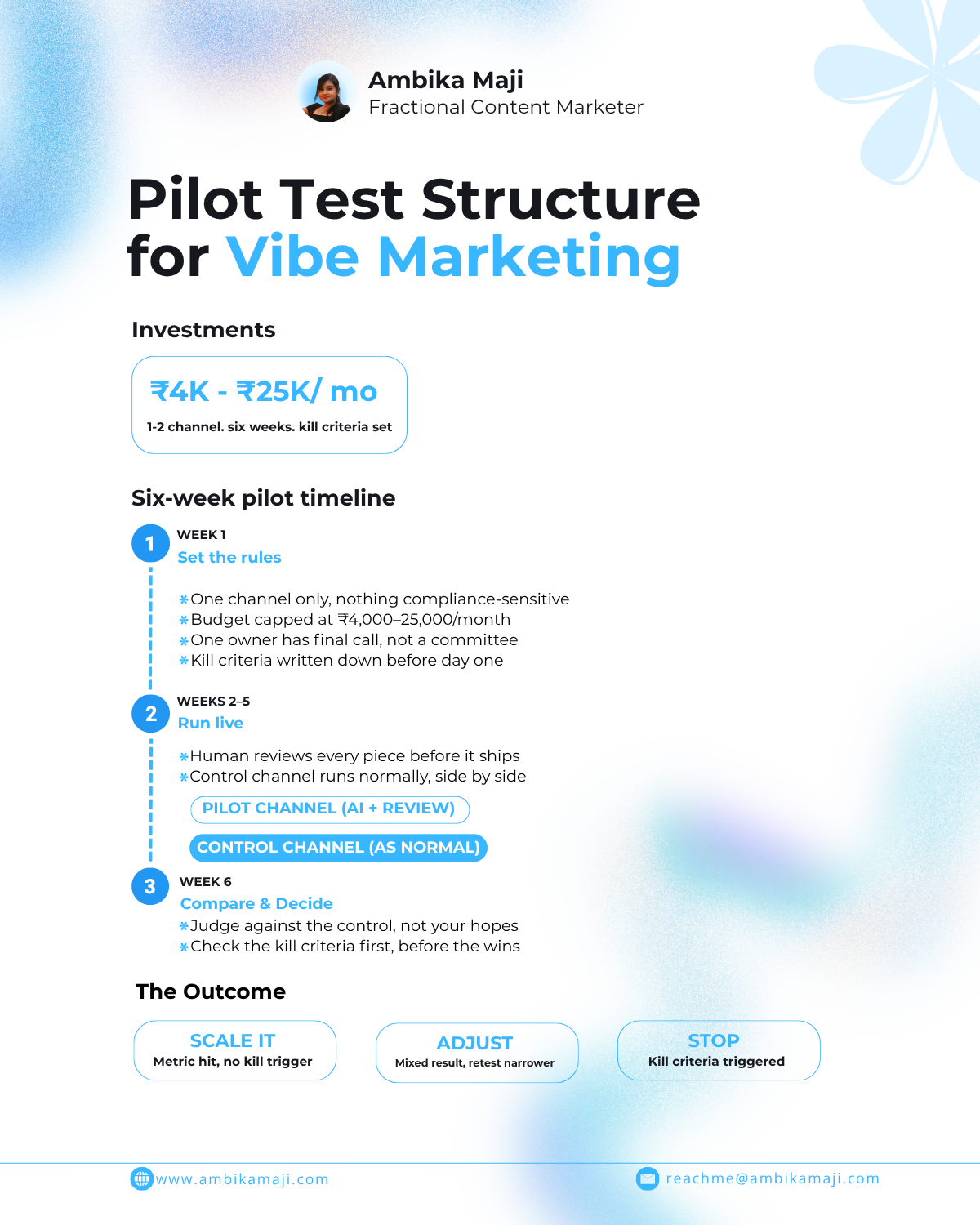
For any business, it makes sense to test a new system before committing time and capital to it. So, I recommend going for a pilot.
Here’s a low-risk structure for the pilot.
Pick one channel
LinkedIn posts or email sequences are good starting points. They are visible enough to judge quality, low-stakes enough that a miss doesn’t cost a lead. Skip anything compliance-sensitive for this first round.
Set a budget ceiling before you start
A working AI tool stack for marketing costs ₹4,000-25,000/month in India. If there’s more work for AI delegation, it can go between ₹15,000-60,000/month.
However, this largely depends on the AI tools you need. This budget is not a hard and fast rule, but try to stick around it. If a tool exceeds the pilot budget but it turns out to be good for your team, splurge a bit to test thoroughly.
Assign one decision-maker
Too many cooks spoil the broth. This applies to your pilot project too. Have one decision-maker for each tool. Assign the task to experienced professionals from the pre-AI era.
Let them go through the AI-generated pieces to assess quality and decide whether each one is publishable.
Let your team review each piece
Ensure your team reviews each AI-generated piece. Not only for quality, but to check productivity improvement.
The pilot project tests the AI+ Human model. Both your team and the tool are being tested here. Is the tool helping save hours? Is it taking more time to edit and fix? Is it easy to use? And so on.
Decide your success metric
Set benchmarks to calculate success in advance. Learn the tool’s features and how it has helped others, and use those to set your metrics.
Run it against your usual process
Don’t pause your ongoing system. Keep doing the usual manual work alongside vibe marketing. Do A/B testing to compare results. For example, work on five LinkedIn posts using AI and five manually. Analyze how they perform. This makes the comparison honest.
Set kill criteria
Define clear kill criteria using existing case studies to establish what “not working” looks like. For example, if ROI remains weak, cost per lead increases, and engagement declines — drop it.
| Week | What’s Happening |
|---|---|
| 1 | Metric, budget cap, and kill criteria written down before anything ships |
| 2-5 | Pilot channel runs with mandatory human review; control channel runs as normal |
| 6 | Compare against the usual process, check the kill criteria first |
Pilot projects help avoid major losses.
Currently, there’s a lot of hype around AI usage and vibe marketing. Most founders are looking at AI as mere tools that deliver amazing results. But the reality is slightly different.
Since 2024, I’ve seen several posts and news about founders spending on vibe marketing and vibe coding generously and then regretting it. Around May 2026, an anonymous company received a $500 million invoice in a single month from Anthropic’s Claude.
Also, a mid-market SaaS company invested in four AI marketing tools over 18 months, but its cost-per-qualified-lead increased instead.
A six-week pilot across a few channels costs less. If it fails, you lose less money and team time. Don’t let FOMO drive the decision.
If you really think vibe marketing is the best available option for your business right now, go with a pilot project to confirm it’s the right fit.
Is It Worth It for Your B2B Brand Right Now?
Yes, if your brand positioning, marketing team, and other operational systems are in place and you want to execute faster.
No, if you are hoping AI will take care of your strategy, plan, and execution with minimal human intervention.
Vibe marketing works best for brands who already have a human-run system in place (even if it’s small-scale). AI can enhance your marketing efforts and outcomes, but it requires human judgement at all times.
If you’re stuck on whether to go ahead with vibe marketing (with budget) but need someone to steer it, I can support you.
Let’s get on a 30-minute 1:1 consultation call to decide how we can collaborate and structure your vibe marketing system.
Frequently Asked Questions
About the author

Ambika Maji
Ambika Maji is a fractional content marketer and a freelance SEO content writer with 8+ years of experience. She helps B2B brands turn content into a growth lever, specializing in SEO content, B2B content strategy, and social media content. She writes data-backed blogs on content marketing, SEO, AI content, MarTech, and productivity. Off work, she's usually lost in a book on Hindu mythology or charting her next move in Vedic astrology.