From 2026 onwards, most Indian startups will likely be AI-native or AI-forward, with lean teams of around 5-6 people.
At the same time, fractional content marketers have been gaining traction in India over the past 3-4 years.
Because they are:
- More cost-effective than hiring a full in-house team
- Focused on specific, outcome-driven goals
- Not tied to long-term commitments
- Driven to deliver results within fixed timelines
A fractional content marketer may seem like just another vendor, but in reality, they function like content head.
That’s what makes it a win-win.
You skip the lengthy hiring process while still getting someone who takes ownership of your content.
That said, this only works if the product or service is already strong.
If you’re wondering whether a fractional content marketer is the right fit for your B2B business, this guide will help.
How a fractional content marketer helps early-stage B2B businesses grow?
Fractional content marketers do much more than create content. They:
Build your content strategy from scratch
When you’re running an early-stage startup, you rarely have the time to audit the market, stalk your competitors, or map out Ideal Customer Profile (ICP).
That’s exactly where a fractional content marketer can support.
They build a real content strategy tied directly to your sales pipeline and works on the execution too.
Define your brand voice and messaging
They shape a distinct brand identity instead of copying competitors.
More importantly, they maintain consistency across every touchpoint, from your website and LinkedIn to email campaigns and cold outreach.
Create and manage your content calendar
They take ownership of planning and publishing, so your content isn’t created on an ad-hoc basis.
The calendar aligns with your sales cycle, demand generation goals, events, and product launches. They also manage the tools and workflows needed to maintain quality and consistency.
Produce high-value content
Most fractional content marketers bring solid mid-level experience, which reflects in the quality and variety of content they produce.
For example, I work on SEO blogs, LinkedIn posts, e-books, social media content, research-backed articles, and case studies. When needed, I also bring in experienced freelancers to support execution without compromising quality.
Optimise for SEO, GEO, and organic growth
Most fractional content marketers understand their industry well, helping them identify the right keywords and search intent quickly.
They create content that ranks on search engines and gets picked up by AI, often using pillar pages and topic clusters. This also reduces your dependence on paid ads.
Enable your sales team
They create one-pagers, cold email templates, email sequences, and LinkedIn content that support sales.
By working closely with your sales team, they help nurture leads and move them through the funnel faster.
Measure what’s working
They take ownership of performance by tracking metrics such as traffic, engagement, leads, and conversions.
For example, while managing LinkedIn for a TIC company, I noticed carousel + text posts consistently outperforming other formats. So, I started creating more of them, even though it wasn’t part of my original scope.
I also explained the reasoning to the client so they could continue the approach even if we stopped working together.
Performance measurement is critical because algorithms keep changing. What worked two months ago may not work today.
Manage your content ecosystem
A strong content engine involves multiple moving parts, from freelancers and vendors to tools and workflows. A fractional content marketer coordinates all of them.
They identify the right freelancers or agencies while you approve the budget. They also handle negotiations, timelines, and paperwork, taking a significant load off founders and marketing heads.
For example, when I manage end-to-end content projects, I coordinate website developers, designers, and content specialists. Since I already have a network, the hiring process is faster and pricing negotiations are smoother.
Act as a strategic thought partner
A fractional content marketer often functions like a part-time content CMO. Their role goes beyond execution to advising on positioning, GTM priorities, and content investments.
They align content with your business goals and use it strategically to support growth.
I’ve often seen companies hire fractional marketers only for execution while keeping strategy completely internal. But in my experience, the best results come when business goals are shared openly and the conten marketer is involved in strategic discussions.
When working with clients, I don’t just execute. I regularly suggest positioning angles, content opportunities, and sales enablement ideas based on what’s working and what’s not.
This doesn’t reduce your control. It brings in specialised expertise that helps you move faster.
Content takes time to compound, so early results may seem slow. But over time, it becomes a sustainable growth channel.
Companies that rely only on paid ads for quick wins while neglecting organic content often end up spending more without building long-term momentum.
I often see small B2B businesses hire freelancers for one-off tasks to force growth. But when you execute without a strategic roadmap, those investments usually misfire.
For example, spending ₹20,000 every month on LinkedIn content for a year while neglecting website messaging. Even if someone discovers you on LinkedIn, poor website messaging can make them leave without converting.
There’s also a common misconception that fractional roles and freelancing are the same. They are NOT.
Fractional content marketer vs freelancer
At first glance, hiring a fractional content marketer may seem similar to hiring a freelancer. Both work part-time and are often hired for a fixed duration.
The difference is ownership.
A freelancer focuses primarily on execution. You define the tasks, and they deliver them. The business outcome isn’t always their responsibility.
A fractional content marketer takes ownership of strategy, planning, execution, and leadership.
To make this clearer, here’s a quick comparison.
| Feature | Fractional Content Marketer | Freelancer / Contractor |
|---|---|---|
| Role | Owns strategy, execution, and results | Executes assigned tasks |
| Scope | Strategy, SEO, content, distribution, analytics | Writing, editing, design |
| Commitment | Long-term retainer, embedded with the team | Project-based or monthly deliverables |
| Management | Self-managed, requires minimal oversight | Requires briefs, reviews, and coordination |
| Investment (INR) | ₹80,000-₹2,50,000/month | ₹15,000-₹60,000/month |
| Focus | Business outcomes (traffic, leads, revenue) | Content outputs (blogs, posts, assets) |
| Best For | Companies building a content engine | Companies with an existing strategy needing execution support |
The concept of fractional professionals is still relatively new. Some people see it as a rebranded version of part-time consulting.
But there’s a key difference.
Consultants usually stay at the strategic level, while fractional professionals are more hands-on. They combine strategy with execution and often come from an execution-first background.
Fractional content marketer vs agency
Agencies are another popular option for B2B startups and small businesses.
I’ve worked with agencies during my full-time roles, expecting faster and better results. But like any hiring model, there are trade-offs.
The level of ownership, communication, and execution can be very different from working with a fractional content marketer.
Here’s a quick comparison.
| Feature | Fractional Content Marketer | Agency |
|---|---|---|
| Role | Embedded strategic content lead | External content team |
| Scope | Strategy, planning, oversight, execution | Content production, campaigns, some strategy |
| Commitment | Flexible ongoing retainer | Monthly or project-based contract |
| Management | Works directly with your team | Managed through account managers |
| Investment (INR) | ₹25,000-₹1,50,000/month | ₹50,000-₹5,00,000+/month |
| Focus | Long-term growth and consistency | Speed, scale, and campaign execution |
| Best For | Startups needing strategic support | Companies needing high-volume execution |
When you hire an agency, having an experienced in-house point of contact is essential.
Agencies can miss business nuances, and they often charge a premium. Since they manage multiple clients, higher-paying accounts usually get more attention. That’s understandable, but not ideal if you’re one of their smaller clients.
One way around this is to work with a newer agency that’s 3-4 years into business. They’re often more invested in building long-term client relationships.
Even then, you need someone internally who can manage the agency and provide clear direction.
Fractional content marketer vs In-house
The other option is to build an in-house content marketing team instead of outsourcing.
This usually makes sense for startups and small businesses with strong funding and the budget to hire full-time talent.
I’ve worked in in-house content teams for the past 5-6 years, and like every hiring model, it comes with its own advantages and limitations.
Here’s how it compares with a fractional content marketer:
| Feature | Fractional Content Marketer | In-House Content Marketers |
|---|---|---|
| Primary Role | Part-time strategic expert guiding content direction | Full-time employees managing content internally |
| Scope of Work | Strategy, systems, mentoring, selective execution | End-to-end execution, coordination, and internal alignment |
| Commitment | Flexible, part-time engagement | Full-time (40+ hours/week) |
| Management | Independent, requires minimal supervision | Needs onboarding, management, and performance tracking |
| Investment (INR) | ₹25,000 - ₹1,50,000/month | ₹4,00,000 - ₹12,00,000/year (CTC + overheads) |
| Expected Results | Faster strategic clarity, structured growth, better ROI on content | Consistent execution, deeper brand understanding over time |
| Best For | Early-stage startups, founders needing direction without full hire | Growing companies ready to build an internal content function |
Hiring full-time means committing to content marketing for the long run. I’ve seen companies build content teams and shut them down within 3-4 years due to budget cuts or a lack of visible ROI.
An in-house hire is a significant investment. If you’re still testing content marketing and hire someone with only 1-2 years of experience, it can backfire.
Lower salaries may fit your budget, but weak fundamentals rarely deliver long-term results.
In-house teams make sense when you’re ready to invest consistently for the next 5-8 years and have the budget to support it.
If you’re still experimenting or working with a limited budget, outsourcing is often the safer option. It reduces financial risk and helps you avoid repeated hiring and layoffs, which can hurt your reputation in the early years.
Why do B2B startups in India struggle with content marketing?
Most B2B startups operate on limited budgets, so content marketing rarely gets priority. Instead, they invest in experienced sales professionals who promise conversions, not lead generation.
Content is often treated as an afterthought.
Random posts are published across LinkedIn, websites, and other channels without a clear strategy. Many companies copy competitors without considering differences in positioning, audience, or business goals.
It results to low reach, weak engagement, and content that feels disconnected.
It gets published but doesn’t contribute to growth. Over time, teams burn out and ROI suffers.
This applies across formats, whether it’s social media, blogs, or email marketing.
AI can help with execution and even parts of strategy, but only when it’s guided by experience and a solid understanding of the market.
For example, I recently came across a young company that had just started posting on LinkedIn. Most of its content consisted of festival greetings, with the occasional sales-heavy post.
Like this.

If you’ve spent 3-6 months posting mostly AI-generated content, festival greetings, and promotional posts, and only friends or colleagues are engaging, it’s probably time for a more structured content approach.
When should you hire a fractional content marketer?
A fractional content marketer makes sense if you:
- Tried AI-led content for 3-6 months without seeing results
- Want to test content marketing before making a long-term commitment
- Don’t have the time to build a content engine
- Need content to nurture leads and customers
- Can’t yet justify a full-time hire
- Have founders creating content, and it’s becoming a bottleneck
- Need support for seasonal campaigns or product launches
- Don’t have an internal marketing team
- Are still validating your ICP and experimenting with messaging
For most startups with limited budgets, starting with AI is a practical choice. With the right inputs, it can support both strategy and execution.
If you need someone to oversee the process, hiring an experienced in-house content marketer (5-7 years) and equipping them with the right AI tools can work well.
This approach is often called vibe marketing and can be effective for early-stage growth.
But if you’re not ready for a full-time hiring commitment, a fractional content marketer offers the same strategic support with far more flexibility.
Here’s a quick comparison.
Why most B2B fractional content setups fail (and how to avoid it)
Fractional content marketing isn’t all upside. Here are a few limitations to keep in mind.
Limited product or service knowledge
It takes time to understand a product or service deeply. Even for me, it takes 3-4 months to get comfortable with a new company, and much longer to fully understand its operations.
Since fractional marketers have limited access to internal teams, they can miss important differentiators. In B2B, your audience notices these gaps quickly.
They may also work with your competitors
Most fractional marketers specialise in a niche, which helps them ramp up quickly. But it also means they may work with your competitors.
Like any service business, higher-paying clients often get more attention.
I’ve experienced this myself.
While I was working full-time, there was one vendor delayed a design project for over two years because they prioritised larger clients.
Too many meetings, not enough execution
Some fractional marketers are great at strategy discussions but struggle with execution.
I’ve seen this firsthand. One marketer I worked with had excellent ideas and presentations, but a straightforward copywriting project kept getting delayed.
Always evaluate work samples and delivery history, not just how well someone presents ideas.
No clear handover
Vendor disputes are more common than most founders expect.
Recently, I spoke with a Head of Marketing whose video project ended badly because the contract didn’t include ownership of the raw files. When the engagement ended, the company couldn’t reuse the footage.
Always include handover clauses and a transition plan in your contract.
Hiring without a strategy
Content only works when it’s aligned with business goals.
I’ve seen founders hire fractional marketers to copy competitors. The brief often starts with, “We want something like XYZ.”
Without validating your ICP or positioning, that rarely works. Good execution can’t compensate for a weak strategy.
You eventually outgrow fractional support
Fractional marketers are great for building momentum, but they’re rarely a permanent solution.
As your content engine grows, you’ll eventually need a full-time team. If you already have the budget and long-term clarity, hiring in-house earlier may make more sense.
How much does a B2B fractional content marketer cost in India?
A fractional content marketer typically costs more than a freelancer but less than an agency.
For end-to-end support in India, expect to pay ₹60,000-₹1,20,000 per month, depending on experience and industry.
If your budget is around ₹40,000 or less, you’ll usually get execution support rather than strategic ownership.
Here’s a quick comparison.
| Level | Monthly Retainer | Focus |
|---|---|---|
| Mid-Level (4-7 yrs) | ₹40,000-70,000 | Strategy, content, SEO |
| Senior (7-12 yrs) | ₹75,000-1,20,000 | Strategy, editorial, distribution, vendor management |
| Fractional Head of Content (12+ yrs) | ₹1,25,000-2,50,000 | End-to-end content leadership |
| Engagement | Cost Range |
|---|---|
| Blog post | ₹3,000-8,000 |
| Monthly retainer | ₹40,000-2,50,000 |
| Content audit + strategy | ₹25,000-75,000 |
| Campaign or launch project | ₹60,000-2,00,000 |
| Location | Pricing Impact |
|---|---|
| Bengaluru / Mumbai | +20-30% above base rate |
| Delhi NCR | +15-20% above base rate |
| Pune | Base rate |
| Tier 2 / Remote | -10-20% below base |
Is a fractional content marketer right for your B2B business?
When B2B companies decide to invest in content, the usual options are:
- Hire a full-time content marketer
- Work with an agency
That’s what I’ve seen over the past eight years. But in the early stages, neither is always the right fit.
A full-time hire needs direction, time, and a long-term budget. Agencies can execute well but often lack deep alignment with your business.
This is where a fractional content marketer fits.
They don’t just fill a gap. They work as an extension of your team, taking ownership for a fixed period.
For example, when I work with clients, I collaborate directly with a point of contact for a set number of hours or on regular basis. I don’t just execute tasks. I track performance, suggest improvements, and recommend dropping activities that aren’t delivering results.
A fractional content marketer is a good fit if you’re unsure:
- Which content activities deserve your attention
- What to say (and what to avoid)
- How to stay consistent without wasting time and budget
I’ve met many founders and marketing heads who consider this, assuming it’s budget-friendly.
But for it to work, two things need to be true:
- You agree content is a long-term growth channel.
- Your team is willing to collaborate.
It usually doesn’t work if:
- Leadership doesn’t trust in content marketing
- You expect high output with little involvement
- You’re chasing quick wins over long-term growth
- Your goals aren’t clearly defined
Simply put, working with a fractional content marketer works when you realize you don’t need more content but you need the right content.
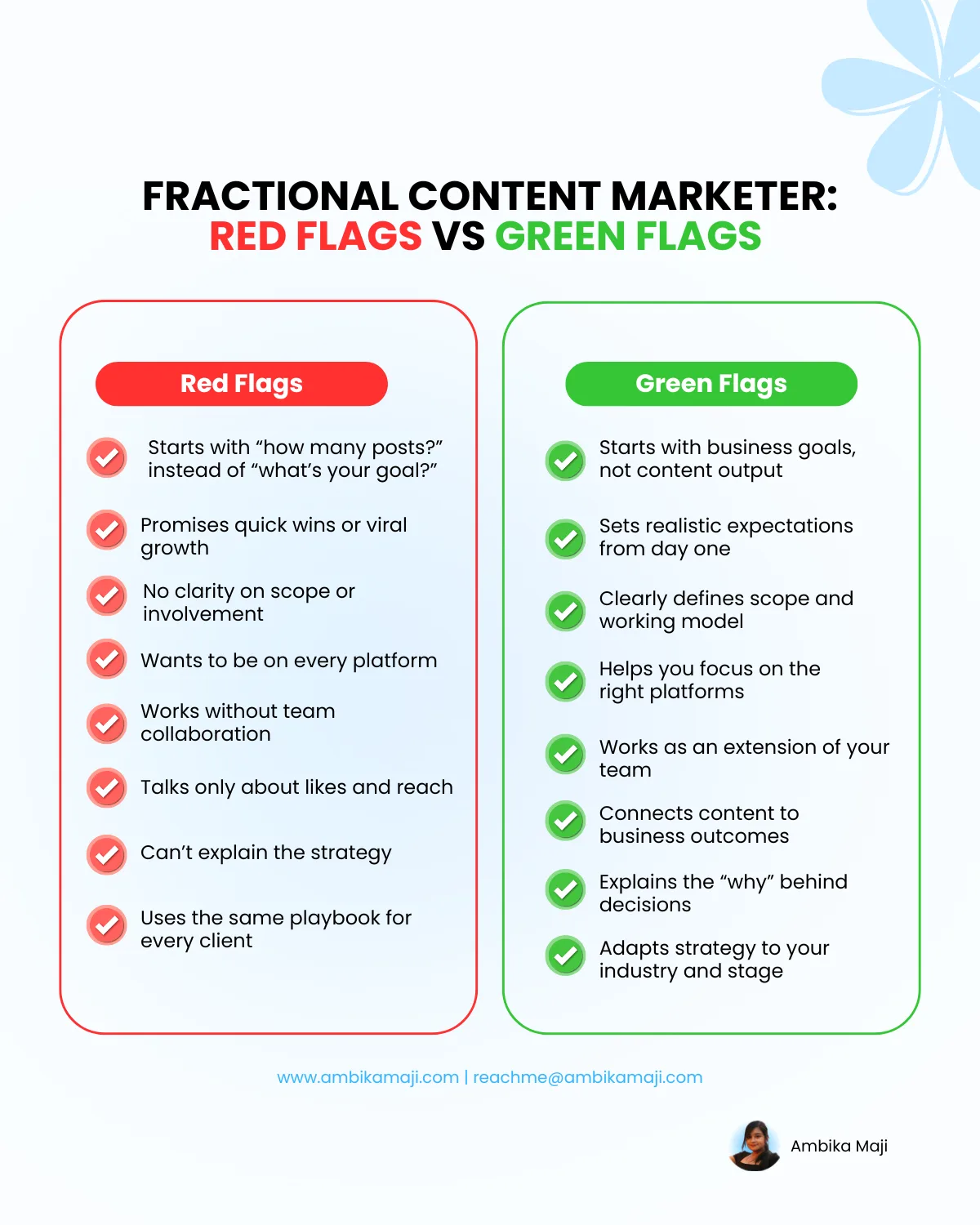
How to identify a reliable B2B fractional content marketer
Not everyone offering fractional services works strategically. Many freelancers rebrand themselves while continuing to operate as execution partners.
A true fractional content marketer acts as a strategic partner with relevant industry experience.
You’ll notice this not just in their portfolio, but in how they approach your business.
Here’s what to look for.
They…
Ask the right questions
They don’t just ask how many blogs or posts you need. They want to understand your business model, ICP, sales cycle, and goals.
Prioritise strategy first
Before creating content, they define positioning, messaging, and priorities. Without direction, consistency alone won’t deliver results.
Tell you what not to do
In the early stages, doing fewer things well is better than trying everything. If someone agrees with every idea or trend, that’s usually a red flag.
Integrate with your team
They work as an extension of your team, not just another vendor. Communication, collaboration, and feedback are part of the process.
Focus on business outcomes
Traffic and impressions matter, but they also connect content to leads, pipeline, hiring, or brand awareness wherever possible.
Set realistic expectations
Content takes time, especially in B2B. If someone promises quick results before understanding your business, be cautious.
Where to find B2B fractional content marketers for hire
You can find fractional content marketers on several platforms, but the quality varies.
Here are the ones I recommend.
Most B2B content marketers are active on LinkedIn. Search within your industry and network.
Don’t judge someone only by their posts. Review their work experience to see if they’ve worked in your industry. If they have, book an introductory call. Most offer one for free.
Referrals and founder communities
Referrals are often the best source. If someone has already worked with people in your network, you’ll get more honest feedback than from testimonials alone.
Ask in your WhatsApp groups, Slack communities, or founder circles.
Freelance marketplaces
Platforms like Upwork and Fiverr can work if you filter carefully.
Search for content strategist or content marketing consultant instead of just content writer. Many fractional marketers position themselves this way.
Agencies offering fractional support
Some newer agencies now offer fractional-style services backed by an execution team. This can work well, but dedicated attention may be limited.
Before hiring, ask around in your network. A quick reference check can save you from expensive mistakes.
What does the first 30-60-90 days look like?
A good fractional content marketer keeps the entire process transparent, from strategy and trackers to execution and reporting.
If you’ve never worked with one before, here’s what the first 30-60-90 days typically look like.
| Timeline | Focus | Fractional Content Marketer | Your Role | Outcome |
|---|---|---|---|---|
| 0-30 Days | Strategy | Understand the business, audit content, define ICP, messaging, and content pillars | Share product, sales, and customer insights | Clear strategy and roadmap |
| 30-60 Days | Execution | Create content, test formats, build workflows, and distribute content | Review content and provide feedback | Consistent output and early learnings |
| 60-90 Days | Optimisation | Scale what works, refine messaging, and align content with pipeline | Share case studies and business updates | Better performance and early traction |
What kind of content does a fractional content marketer create?
The short answer: whatever your business needs at its current stage.
A good fractional content marketer doesn’t create content based on trends or competitors. They choose formats that support your business goals, audience, and stage of growth.
In B2B, this usually includes:
- Thought leadership to build authority
- Problem-led content to attract the right audience
- SEO content to capture high-intent search traffic
- Case studies to build credibility and trust
- Sales enablement content such as one-pagers, email sequences, landing pages, and brochures to support conversions
The mix changes as your business grows.
For example, an early-stage startup usually benefits more from SEO-driven and problem-led content than thought leadership. Once you’ve built credibility and won a few clients, case studies and thought leadership become much more effective.
The goal isn’t to create every type of content. It’s to create the right content at the right time.
Which results are realistic (and which aren’t)
B2B content marketing takes time. The returns can be significant, but organic growth is rarely fast.
One thing every founder should know: no marketer can promise virality in B2B.
I still remember a client from my agency days who expected an organic social media post to go viral the same day it was published.
That’s not how content marketing works.
If your goal is immediate reach, you’ll usually need paid ads alongside organic content.
Here’s what you can realistically expect.
| Area | Realistic Expectation | Don’t Expect |
|---|---|---|
| Strategy | Clear messaging and content direction | Instant perfect positioning |
| Content | Consistent, goal-driven content | Viral posts every week |
| Engagement | Steady growth in engagement | High reach on every post |
| Audience | Gradual growth of the right audience | Rapid follower growth |
| Leads | Early conversations and occasional inbound leads | Predictable leads in a few months |
| ROI | Better insight into what works | Instant ROI from every post |
| Team | Better marketing-sales alignment | Zero founder involvement |
From what I’ve seen, B2B content marketing usually takes 8-12 months to show meaningful traction. There’s no overnight playbook. It compounds through consistent execution over time.
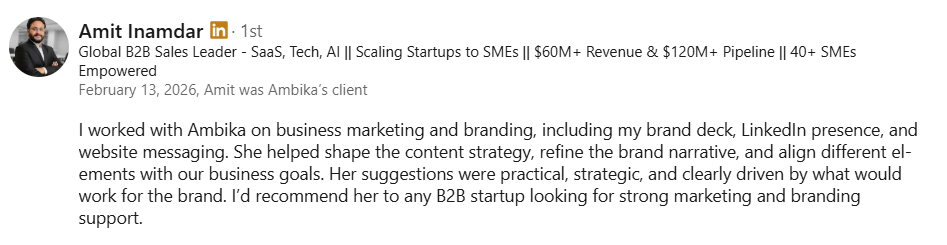
For example, I’ve myself closed a client purely through LinkedIn organic content. Out of 4-5 inbound calls within a year, only one converted, with zero ad spend.
The client had been following my content for a while before reaching out for their new startup.
One of my acquaintances, who has been running a marketing agency for over two years, gets around 5-6 discovery calls every month, mostly through LinkedIn.
She outsources her LinkedIn organic content to a LinkedIn specialist for around ₹12,000-15,000 per month. That alone consistently brings in 5-6 calls each month, with a few converting into clients. Alongside this, she manages some content herself and outsources the rest.
How does content tie back to revenue?
Fractional content support rarely generates revenue directly. It isn’t sales, it supports sales.
In B2B, content builds awareness, trust, and credibility long before someone is ready to buy. As people repeatedly engage with your content, they become familiar with your expertise, making sales conversations shorter and easier.
By the time a prospect reaches out, they already understand what you do and how you can help.
If you expect a fractional content marketer alone to generate leads and close deals, you’ll be disappointed. Content works alongside sales, not instead of it.
Think of it this way: content attracts and nurtures the right audience, while sales converts them into customers.
What happens if content doesn’t work?
When content underperforms, it’s rarely because content marketing itself doesn’t work. More often, the fundamentals are weak.
Common reasons include:
- Unclear positioning or messaging
- Poorly defined audience
- Unrealistic expectations
- Inconsistent execution
- Limited founder or team involvement
- No clear ownership
In most cases, you don’t need to start over.
You need to:
- Narrow your audience
- Refine your messaging
- Improve content formats or distribution
- Align content with sales
Content is iterative. It improves through collaboration, testing, and refinement, not one-time planning.
I’ve experienced this firsthand.
For example, I worked with a client between 2024 and 2025 across B2C and B2B. She handed over the entire content function but expected virality within 3-4 weeks. I repeatedly explained that it doesn’t work like that.
There’s no shortcut or “magic wand” to make content deliver overnight. To her credit, she eventually understood the process. But there was still little to no input from her side.
And that’s where things started breaking.
Content doesn’t work in isolation. It needs collaboration. Without founder or team input, it becomes generic.
I continued executing, but without context or direction, the content lacked depth.I could have kept going as many setups do, pushing out high volumes of generic content.
But I knew it wouldn’t lead to meaningful results. So I stepped away.
She later hired an agency that matched her expectation, high output, low strategy.
Did it work? No.
The content was consistent, but there was no engagement or ROI.
I’ve seen this pattern repeatedly. If a fractional marketer focuses only on publishing content, without a clear strategy, the results will almost always disappoint.
Those services are often cheaper because they optimise for execution, not thinking. Many startups choose them because they fit the budget, only to abandon content marketing later, believing it doesn’t work.
Can a fractional content marketer actually support your B2B business?
Yes, if you need direction, not just execution.
A fractional content marketer helps you decide what to say, who to say it to, and how content supports your business goals.
That’s often what’s missing in early-stage teams.
A fractional content marketer can also help you generate 3x more leads than traditional marketing at 62% lower cost .But those outcomes depend on having a clear strategy behind the content.
So, a fractional hire can truly help your business when:
- You don’t need a full-time hire yet
- Your content lacks direction or consistency
- You want content to support long-term growth
It won’t work if you’re expecting instant results or complete hands-off execution.
So, If you’re considering fractional content support for your busines and want to get a head start, feel free to book a 1:1 consultation call or email me at reachme@ambikamaji.com.
Note: I used AI to assist with parts of this article. I reviewed, edited, and fact-checked every section before publishing.
Frequently Asked Questions
About the author

Ambika Maji
Ambika Maji is a fractional content marketer and a freelance SEO content writer with 8+ years of experience. She helps B2B brands turn content into a growth lever, specializing in SEO content, B2B content strategy, and social media content. She writes data-backed blogs on content marketing, SEO, AI content, MarTech, and productivity. Off work, she's usually lost in a book on Hindu mythology or charting her next move in Vedic astrology.