“If you want to get cited on any Gen AI tool, you’ve to publish your thesis statement in the first 150 words of your content.” This is kinda the thumb-rule.
So, for example, if you are writing a piece on “What’s vibe marketing?”, you’ve got to add the vibe marketing definition right after the introduction, or make it the introduction — a paragraph on it, or a bulleted section.
Another way to add it is using the “TL;DR”,“Key Takeaways” or “Summary”. Just add in the “query” question strategically right before this section and ensure your intro section is low word count.
However, there’s an issue with the “First 150 Words Rule”. Different GEO/SEO experts have a different say on the number. So, I did my end of research to find out which is the best position!
I had to because I even need to pull traffic and lead on my website.
-
The rule: Put your thesis or direct answer in the first ~150 words.
-
The evidence: Kevin Indig’s study of 1.2M ChatGPT responses found 44.2% of citations come from the first 30% of a page.
-
The caveat: “150 words” is a translation of that finding, and it only fits pieces of about 600-1,000 words.
-
The psychology: The primacy effect shows up in both humans and LLMs, so writing for AI and for skimmers is the same job.
-
How to apply it: Lead with the answer, add one concrete fact, then add brief context, and build a first-150-words check into your content process.
The word-count disagreement
After I read that the thesis placement is a key to your AI-citation, I did a little research. I found only two pieces of relevant data.
I’m adding them below with the dates, because as of 2026, we all know how fast the algorithms are changing:
- Writesonic suggests adding the main stuff right in the first 1-2 sentences of your content. This was published in March, 2026.
- CXL, which offers courses and resources on marketing, says adding thesis statements within 150-200 words. Reason: AI doesn’t read your full content. It will read only 30% and pull the relevant data. They shared this in March, 2026.
The core evidence: Kevin Indig’s “ski ramp”
I went through a couple of reddit threads on this topic and the only study that got cited almost everywhere was Kevig Indig’s “ski ramp”. Even CXL has mentioned this particular study.
However, there’s another study I found worth going through: Cyprus Shepherd’s AI ranking factor analysis. In his analysis, he emphasizes on keeping the “answer” or “thesis statement” at the beginning of the content.
Now, let’s get on to Kevin Indig’s study.
By the way, Kevin Indig is an independent growth advisor who has formerly worked with Shopify and G2. He publishes on Growth Memo, a substack email newsletter and he’s also an author at Search Engine Land.
Kevin ran the largest transparent study currently available. In “The Science of How AI Pays Attention” (gated stuff) he examined 1.2 million ChatGPT responses and 18,012 verified citations.
The central finding:
- 44.2% of citations come from the first 30% of a document. After that point, citation likelihood drops sharply. Indig calls the distribution the “ski ramp.” Citations peak early and then decline.
- 53% of citations are drawn from the middle of paragraphs, 24.5% from first sentences, and 22.5% from last sentences.
The system is not simply grabbing the opening sentence of every page. It is overweighting the early portion of the page while still sampling internal structure.
A companion study (“The Science of How AI Picks Its Sources”) looked at roughly 98,000 citation rows and found that within any given topic, about 30 domains capture 67% of all citations. Placement alone will not rescue a low-authority domain.
A third Indig analysis of 815,000 query-page pairs showed that focused, shorter pages outperform long “ultimate guides.” A tight, answer-first page beats a meandering introduction every time.
Kevin never mentions about the first 150 word rule though. But his analysis of “first 30%” can be translated to first 150-words. But this makes sense for content of 600-1000 words only.
So, if your word count increases, the first 30% also changes.
Supporting signals from other datasets
A few more datasets that found answer-first formats works include:
-
DerivateX: In their analysis of 1,259 source citations from Google AI Overviews across 100 commercial “best [category] software” searches, covering 20 B2B SaaS categories in June 2026, they emphasize on “answer-first” format.
-
Averi: In it’s Answer Capsule Playbook, they cover about 40-60 words of the main answer right after H2. The found this as a repeating structure pattern on all AI-cited articles.
Even I have used 40-60 word answer capsule right after the first H2. Considering my blogs got AI-cited 20 times within 3 months since I started working on my website, I can vouch that it works.
Two papers give the practical findings additional credibility
Kumar and Palkhouski’s “AI Answer Engine Citation Behavior: Bringing the GEO-16 Framework in B2B SaaS” (September 2025) audited 1,100 URLs and 1,702 citations across Brave, Google AI Overviews, and Perplexity specifically in B2B SaaS.
Pages scoring ≥0.70 on their 16-pillar GEO score achieved a 78% cross-engine citation rate. Overall quality predicted citation with an odds ratio of 4.2.
One of the six core principles they name is “answer-first summary” / “people-first content.”
The foundational GEO paper by Aggarwal et al. (2023) formalized the idea that content creators need deliberate strategies for visibility inside generative engines rather than traditional ranking alone.
It’s human psychology too
Front-loading is not merely an SEO or RAG trick. It exploits a seventy-year-old, extremely well-replicated finding in human memory research and newer work shows large language models have inherited a version of the same bias.
The serial position effect (primacy + recency) is the tendency to remember the first and last items in a series better than those in the middle. It was formally demonstrated by Murdock in 1962 and has roots in Asch’s 1946 impression-formation experiments.
Two different memory systems process the information:
- Short-term memory handles the most recent items.
- Long-term memory and rehearsal favor the earliest items.
A 2024 paper, “Serial Position Effects of Large Language Models”, tested ChatGPT, GPT-3.5, GPT-4, and other models including Claude-instant. The models showed clear primacy effects. The bias is not restricted to a single model family or to humans.
AI does not retrieve your first paragraph solely because of mechanical RAG windowing or chunking. It may also be predisposed to weight early material more heavily — the same cognitive shortcut a human executive uses when skimming.
Writing for the AI Overview and writing for the busy founder who reads the first three lines and decides whether to continue are, structurally, the same task. AI SEO is continuous with good human-centered writing rather than a separate discipline.
Chip Heath and Dan Heath’s Made to Stick supplies a clean framing for the practical implication. The inverted pyramid maximizes information transfer no matter how much of the piece a reader (or model) actually consumes.
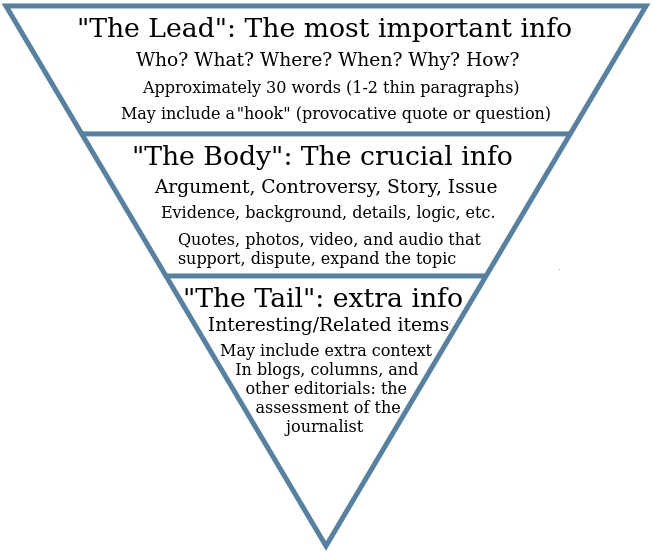
Burying the lead and letting the most important element slip too far down the structure is the exact failure mode both human attention and current LLM citation behavior punish.
The Curse of Knowledge explains why writers do it: they already know the thesis and forget that the reader or the model does not. I’ve done this too!
How to apply the First 150 Words Rule in practice
Treat the opening 150 words of a page (or of a major section) as the citation-critical zone.
Structure it like this:
- Direct answer or thesis in the first 1-2 sentences.
- One concrete supporting fact, number, or distinction immediately after.
- Brief context or qualification so the claim is not naked.
- Clear signal of what the rest of the page will deliver.
Everything after that 150-word block can go deeper, handle objections, add examples, or supply the longer justification. The early block does the citation work; the rest does the trust and depth work.
Optimize the first 150 words of your content
Treat the first 150 words as the most important part of the content. Add it to your content brief, CMS checklist and review process. It’s relevant not only for the AI, but also for your user.
Considering everyone’s skimming these days. It actually make sense to add the thesis statement at the top. Give them what they want as soon as they click on your content link.
Need some help with organic content work for your B2B brand? Schedule a 1:1 call with me today. Let’s discuss how we can improve on what you already have and what to add.
Frequently Asked Questions
About the author

Ambika Maji
Ambika Maji is a fractional content marketer and a freelance SEO content writer with 8+ years of experience. She helps B2B brands turn content into a growth lever, specializing in SEO content, B2B content strategy, and social media content. She writes data-backed blogs on content marketing, SEO, AI content, MarTech, and productivity. Off work, she's usually lost in a book on Hindu mythology or charting her next move in Vedic astrology.