From 2026 onwards, most Indian startups will likely be AI-native or AI-forward, with lean teams of around 5–6 people.
In parallel, fractional content marketers have been on the rise in India over the past 3–4 years.
Why?
Because they are:
- More cost-effective than hiring a full in-house team
- Focused on specific, outcome-driven goals
- Not tied to long-term commitments
- Oriented towards faster results due to fixed timelines
A fractional content marketer may look like just another vendor, but in practice, they function like an owner of your end-to-end content marketing.
That’s what makes it a win-win. No elaborate hiring process, yet your content is handled with accountability.
I know two SaaS founders who hired a fractional content marketer for two years to build their content engine post-traction. That said, it only works if the product or service is strong.
If you’re exploring whether a fractional content marketer makes sense for your SaaS, D2C, or manufacturing business, this guide will help.
What Does a Fractional Content Marketer Do for B2B Startups & Small Businesses?
Fractional content marketers do more than just create content. They:
Build your content strategy from scratch
Most early-stage companies don’t have the time or resources to deeply audit the market, competitors, or define ICPs.
A fractional content marketer steps in to do that and builds a strategy that directly ties content to your pipeline. The focus is not just on impressions or page views, but on meaningful engagement that drives business.
Define your brand voice and messaging
They shape a distinct brand identity that doesn’t mimic competitors but stands out.
More importantly, they ensure consistency across every channel, from your website and LinkedIn to emails and even cold outreach.
Create and manage your content calendar
They take full ownership of planning and publishing, so there’s no ad-hoc content.
The calendar is aligned with your sales cycle, demand generation goals, events, and product launches. They also handle the tools and processes needed to maintain quality and consistency.
Produce high-value content
Most fractional content marketers come with solid mid-level experience, which reflects in the quality and range of content they create.
For instance, I work on SEO blogs, LinkedIn posts, e-books, social media content, research-backed pieces, and case studies. And when needed, I bring in experienced freelancers to support execution without compromising quality.
Here’s my portfolio: Portfolio | Ambika Maji | Content Marketer
Optimises for SEO, GEO, and organic growth
Most fractional content marketers understand their industry well, which helps them quickly identify the right keywords and audience intent.
They build content that ranks or gets picked up by AI, often through structured approaches like pillar pages and content clusters aligned across channels. This also reduces heavy dependence on paid ads.
Enables your sales team
They create assets like one-pagers, cold email templates, sequences, and LinkedIn content to support sales. By working closely with your sales team, they help nurture leads and move them faster through the funnel.
Measures what’s working
They take ownership of performance, tracking metrics like traffic, engagement, leads, and conversion.
For example, while working on LinkedIn for a Testing and Certification company, I noticed carousel + text posts performing better than others. So, I started creating more of that format to improve engagement even though it was not expected of me!
And, I also informed about this change of plan to the client with the reason so they may continue to do the same incase we part our ways.
Performance measurement is critical today, as algorithms keep evolving. What worked two months ago may not work now. That's how fast things are changing.
Manages Your Content Ecosystem
A strong content engine involves multiple moving parts, from freelancers and vendors to tools and processes. A fractional content marketer handles this coordination as part of content operations.
They select the right freelancers or vendors, while you focus only on approving budgets. They also manage negotiations, timelines, and paperwork.This takes a significant load off founders and marketing heads.
For example, when I handle full branding + content projects, I manage hiring across website development, design, and content. Since I already have a reliable network, it saves time and makes pricing negotiations smoother.
Acts as a Strategic Thought Partner
A fractional content marketer often functions like a part-time CMO for content. Their role goes beyond execution to advising on positioning, GTM investments, and overall direction.
They align closely with your business goals and use content strategically to support growth.
I’ve often seen teams limit fractional support to execution and rely only on internal leaders for strategy. But in my experience, the best results come when business goals are clearly shared, and I’m brought into strategic discussions as well.
While working on content for different clients, I don’t just execute. I actively suggest positioning angles, content directions, and even sales enablement ideas based on what’s working and what’s not.
This doesn’t reduce your control; it brings in focused expertise that can move things forward faster. Focusing only on execution often backfires. Content takes time to compound, and early results may seem slow.
But in the long run, it drives sustainable growth.
Companies that rely heavily on paid ads for quick wins, while ignoring organic content, often end up overspending without building lasting momentum.
Organic content marketing is not a pay-and-get activity. It works over the long term. The ROI can be significantly higher than the investment, but it takes time. For example, in one of my previous companies, it took almost a year to see results from SEO. But once the pages started ranking, they continued to bring in leads for the next 2–3 years without any ad spend.
I’ve also seen B2B startups and small companies hire freelancers for isolated tasks they assume will help the business grow. But most of the time, when someone without hands-on marketing experience chooses these tasks without a clear strategy, it backfires.
For example, spending ₹20k per month for a year only on LinkedIn content, while completely neglecting website content. Even if a potential lead lands on the website, weak messaging can make them drop off.
There’s a common misconception that fractional roles and freelancing are the same, but they differ fundamentally.
Fractional Content Marketer Vs Freelancer
On the surface, it may seem similar to hiring a freelancer; part-time, for a specific project and duration. But the key difference is this: a freelancer focuses only on execution.
You tell them what needs to be done, and they deliver on that. The outcome is not always their responsibility. A fractional content marketer, on the other hand, takes ownership of strategy, planning, execution, and leadership.
To make this clearer, here’s a quick comparison.
| Feature | Fractional Content Marketer | Freelancer / Contractor |
|---|---|---|
| Primary Role | Strategic Partner & Leader: Acts as a part-time Head of Content. Owns the strategy, calendar, distribution, and results. | Execution Specialist: Acts as an external pair of hands. Executes specific tasks (writing, editing, designing) based on a given brief. |
| Scope of Work | End-to-End Ownership: Content Strategy & Planning SEO & Keyword Strategy Managing Writers/Designers Distribution & Repurposing Analytics & ROI Reporting | Task-Based Execution: Writing Blog Posts/Whitepapers Creating Social Media Copies Basic Editing Requires you to provide the topics, keywords, and briefs. |
| Commitment | Long-term Retainer (6-12 months): Embedded in your team, attends internal stand-ups, and uses your Slack/Teams. | Project or Transactional: Ad-hoc projects or monthly deliverables. Interaction is usually limited to emails or review calls. |
| Management | Self-Managed: They manage themselves and often your junior writers or other freelancers. Requires minimal hand-holding. | Requires Management: You must provide detailed briefs, manage deadlines, and review quality. Requires your time to coordinate. |
| Investment (INR) | ₹80,000 – ₹2,50,000 / month (Fixed Retainer) | ₹15,000 – ₹60,000 / month (Per piece or low-volume retainer) |
| Expected Results | Outcomes (Business Growth): Increase in organic traffic & leads Brand authority & share of voice Clear attribution of content to revenue | Outputs (Deliverables): X Blogs per month X Social posts Completed drafts on time |
| Best For | Early-stage SaaS/Tech startups need a content engine without hiring a full-time CMO/Head of Content. | Companies with an existing strategy and a marketing manager who just need help creating the content volume. |
The concept of “fractional” professionals is still fairly new.Some see it as just a rebranded term for part-time consultants.
But consultants typically stay at a strategic level and are less involved in execution. Fractional professionals, on the other hand, are usually more hands-on and often come from a younger, execution-driven background.
Fractional Content Marketer vs Agency
Agencies are another popular choice for B2B startups and small companies. During my full-time roles, I’ve outsourced marketing work to agencies, expecting faster and better results.
But like any model, there are trade-offs. The approach, ownership, and outcomes can differ quite a bit from working with a fractional content marketer.
Here’s a quick comparison for clarity.
| Feature | Fractional Content Marketer | Agency |
|---|---|---|
| Primary Role | Acts as a part-time strategic content lead embedded in your business | External team delivering content services across multiple clients |
| Scope of Work | Strategy, planning, execution oversight, and sometimes light creation | Execution-heavy: content production, campaigns, sometimes strategy |
| Commitment | Fixed hours per week/month (flexible, ongoing) | Contract-based (monthly retainers or project-based) |
| Management | Works closely with founders/marketing teams, minimal hierarchy | Requires coordination with account managers and multiple stakeholders |
| Investment (INR) | ₹25,000 – ₹1,50,000/month (depending on scope and experience) | ₹50,000 – ₹5,00,000+/month (based on services and agency scale) |
| Expected Results | Consistent brand voice, strategic direction, long-term growth | Faster execution, volume output, campaign-based results |
| Best For | Startups, small teams needing strategy + guidance without full-time hire | Companies needing scale, multiple services, or campaign execution at speed |
When you outsource to an agency, having an experienced in-house point of contact is essential.
Agencies can miss nuances, and they often charge a premium. Since they handle multiple clients, priority usually goes to those with larger or faster-paying contracts.
That’s fair, but not ideal for you if you’re their low-paying client.
One way around this is to work with newer agencies, around 3–4 years into business. They tend to be more attentive and invested in building client relationships. That said, your internal point of contact still needs to be experienced and capable of managing vendors effectively.
Fractional Content Marketer vs In-House
The other option is to not outsource at all and hire an in-house content marketing professional.
This typically works for startups or small businesses with strong funding and the budget to support it.
In India, it’s quite common to build a small in-house team or hire a dedicated content marketer when budgets allow. I’ve worked in such setups myself over the last 5–6 years.
Like the other models, in-house teams come with their own pros and cons.
Here’s how they compare to a fractional content marketer:
| Feature | Fractional Content Marketer | In-House Content Marketers |
|---|---|---|
| Primary Role | Part-time strategic expert guiding content direction | Full-time employees managing content internally |
| Scope of Work | Strategy, systems, mentoring, selective execution | End-to-end execution, coordination, and internal alignment |
| Commitment | Flexible, part-time engagement | Full-time (40+ hours/week) |
| Management | Independent, requires minimal supervision | Needs onboarding, management, and performance tracking |
| Investment (INR) | ₹25,000 – ₹1,50,000/month | ₹4,00,000 – ₹12,00,000/year (CTC + overheads) |
| Expected Results | Faster strategic clarity, structured growth, better ROI on content | Consistent execution, deeper brand understanding over time |
| Best For | Early-stage startups, founders needing direction without full hire | Growing companies ready to build an internal content function |
Hiring full-time means committing to long-term content marketing. I’ve seen companies build teams and then shut them down within 3–4 years due to budget cuts or lack of visible ROI.
An in-house hire or team is a significant investment. If you’re just testing content marketing and bring in someone with 1–2 years of experience, it can backfire.
Lower salaries may fit your budget, but without strong fundamentals, it rarely works long term.
In-house teams make sense when you’re ready to commit for 5–8 years with a substantial marketing budget.
If you’re still in the trial phase or working with a limited budget, outsourcing is a safer option. It reduces financial risk and avoids the cycle of hiring and layoffs, which can hurt your reputation in the early years.
Why Do B2B Startups in India Struggle With Content Marketing?
Most B2B startups operate with limited budgets, and content is rarely a priority. Instead, they invest in experienced B2B sales professionals who promise conversions, not lead generation.
Content, on the other hand, is often done without a plan.
Random posts go out across social media, websites, and other channels with no clear strategy behind them. Many simply copy what competitors are doing, without considering that those brands may have a completely different positioning or audience.
Result?
Low impressions, weak engagement, and content that feels disconnected. It gets posted, but doesn’t drive results. Over time, this leads to burnout and poor ROI.
This applies across formats, whether it’s social media or blogs. AI can help with execution, and sometimes even strategy, but only if you know how to use it well. That comes from experience and a clear understanding of the market.
For example, I recently came across a young company that has just started posting on LinkedIn. Most of their content was limited to festival greetings, with an occasional pushy lead-gen post.
Like this.

If you’ve spent 3–6 months posting mostly AI content, festival greetings, and promos, and only friends or colleagues engage, it’s time for structured content support.
When Should You Hire a Fractional Content Marketer?
Startups and small businesses should consider a fractional content marketer when they:
- Tried AI-led content for 3–6 months and didn’t see results
- Want to test if content marketing works for their niche before committing
- Don’t have the time or bandwidth to build a content engine
- Have reached a stage where nurturing leads and customers through content is necessary
- Aren’t ready to justify a full-time hire’s salary and benefits
- Have founders creating content, and it’s becoming a bottleneck
- Need support for seasonal or campaign-based content
- Don’t have an internal marketing team, but still need a content presence
- Are still validating their ICP and need to experiment before scaling
For most startups with limited budgets, starting with AI is a practical approach. With the right inputs, it can support both strategy and execution.
At this stage, if you want oversight, hiring an in-house content marketer with 5–7 years of experience and equipping them with the right AI tools can work well. This is often referred to as “vibe marketing,” and when done right, it’s effective for early-stage growth.
But if you’re not ready for a long-term hiring commitment, bringing in a fractional content marketer to handle the same responsibilities is a smarter, more flexible option.
Here’s a quick comparison for clarity:
In-House “Vibe” Content Marketer vs Fractional “Vibe” Content Marketer
| Feature | In-House “Vibe” Content Marketer | Fractional “Vibe” Content Marketer |
|---|---|---|
| Primary Role | Fully immersed brand storyteller shaping voice daily | External but embedded expert refining and elevating brand voice |
| Scope of Work | Daily content creation, trend adaptation, and platform management | Voice direction, content themes, creative strategy, selective execution |
| Commitment | Full-time, ongoing involvement | Part-time, flexible engagement (weekly/monthly) |
| Management | Requires hiring, onboarding, and continuous management | Self-managed, collaborates with the founder/marketing lead |
| Brand Alignment | Deep, intuitive understanding of brand over time | Quickly adapts to the brand but may take time to fully internalise the nuances |
| Speed of Execution | High for daily content and reactive trends | Moderate, focused on quality and direction rather than volume |
| Creative Direction | Evolves organically with internal culture and team inputs | Brings external perspective, trend awareness, and structured creativity |
| Investment (INR) | ₹6,00,000 – ₹14,00,000/year (salary + overheads) | ₹30,000 – ₹1,50,000/month depending on scope |
| Expected Results | Consistent content flow, strong brand familiarity | Sharper positioning, distinct voice, better-performing content ideas |
| Best For | Brands building a strong daily social presence and internal culture | Brands needing differentiation, clarity, and creative direction without hiring full-time |
Why Most B2B Fractional Content Setups Fail (And How to Avoid It)
Fractional content isn’t all upside. Here’s where it breaks, and what to watch for:
Limited product or service depth
It takes time to truly understand a product or service. Even for me, a new company takes 3–4 months to get comfortable, and a deeper understanding comes only with regular interaction with the ops team.
With fractional setups, that access is limited. As a result, key differentiators can get missed. In B2B, your audience will spot these gaps quickly, and it can backfire.
They’re juggling your competitor’s work too
Most fractional marketers operate within a niche. That helps them ramp up faster, but also means they may be working with your competitors.
In reality, priority goes to higher-paying clients. I’ve seen this firsthand.
Recently, I worked with vendor who delayed a design project for over 2 years. When I checked their website later, they were clearly focused on bigger, higher-paying brands.
Similarly, an acquaintance of mine, a head of marketing, shared how a fractional marketer delayed a video project by 8 months after taking on a bigger client.
Too many meetings, slow execution
Some fractional hires lean heavily on meetings but lag on delivery.
I’ve experienced this myself while I was employeed. A fractional marketer I worked with would show up for in-person meetings, share detailed ideas and pitches, but when it came to execution, the project kept getting delayed with one reason after another.
This was a fairly straightforward copywriting and editing project, yet it dragged on.
That’s why it’s important to evaluate actual work samples, not just ideas or how well someone presents themselves.
No clear handover or ownership
Disputes with vendors are more common than people expect. I’ve had my share, too, and they can get messy.
Recently, I spoke to a head of marketing who wasn’t happy with a fractional marketer’s video project. But since the contract didn’t mention sharing raw files, the vendor wasn’t obligated to hand them over.
All the effort, from shooting to coordination, went to waste.
I’ve also seen companies outsource everything without building any internal system, so when the vendor leaves, all files and plans go with them. So, always include handover clauses and a basic transition plan.
Founders hire without a strategy
Content doesn’t work in isolation. It needs to align with business goals.
I’ve often seen founders hire fractional support just to replicate what a competitor is doing. The brief usually starts with, “We want something like XYZ.”
But without validating your ICP or positioning, this approach fails.
For example, I’ve seen a company try to replicate podcast strategies of international brands targeting EU audiences, even though their own focus was the Middle East. It didn’t land well.
When you ask someone to copy without a strategy, they will execute, but the results won’t follow.
You outgrow these part-time or fractional content professionals
Fractional support works well at certain stages, especially for testing and building momentum. But it’s not a permanent solution.
I’ve seen businesses reach a point where their content engine starts working, and suddenly they need consistent, full-time effort. That’s where fractional setups fall short.
At some stage, you will need an in-house team. If you already have the budget and clarity, building that early can help you avoid breaks in momentum later.
How Much Does a B2B Fractional Content Marketer Cost in India?
A B2B fractional content marketer typically sits between a freelancer and an agency in terms of cost.
For end-to-end work in India, you can expect to pay anywhere between ₹60,000 and ₹1,20,000 per month, depending on experience and industry.If your budget is around ₹40,000 or lower, you’ll likely get someone focused only on execution, not strategy.
Strategy and planning usually come from professionals with deeper experience, which reflects in higher pricing.
To simplify this, here are some quick comparisons:
| Seniority | Experience | Monthly Retainer | Hours/Month | What’s Included |
|---|---|---|---|---|
| Mid-level | 4–7 yrs | ₹40,000–70,000 | 30–40 hrs | Strategy, writing, calendar, basic SEO |
| Senior | 7–12 yrs | ₹75,000–1,20,000 | 40–60 hrs | Full strategy, editorial, freelancer management, distribution |
| Fractional Head of Content | 12+ yrs | ₹1,25,000–2,50,000 | 50–80 hrs | End-to-end ownership — strategy to reporting, team building |
| Engagement Type | Cost Range |
|---|---|
| Per blog post (ghostwritten) | ₹3,000–8,000 |
| Monthly retainer (part-time) | ₹40,000–2,50,000 |
| One-time content audit + strategy | ₹25,000–75,000 |
| Project-based (campaign/launch) | ₹60,000–2,00,000 |
| City Premium | Adjustment |
|---|---|
| Bengaluru / Mumbai | +20–30% above base |
| Delhi NCR | +15–20% above base |
| Pune | At the base rate |
| Tier 2 / Remote | −10–20% below base |
I bring 8 years of content marketing experience, working across manufacturing, compliance, testing, and MarTech. For end-to-end fractional content support, my pricing starts at ₹70,000 per month, with a minimum commitment of 8 months. Additional vendor and freelancer costs are billed separately.
Is a Fractional Content Marketer Right for Your B2B Startup or Small Company?
When B2B companies begin thinking about content, the usual options are:
- Hire a full-time content marketer
- Outsource to an agency
At least, that’s what I’ve seen in my 8 years of experience. But in the early stages, neither always fits.
A full-time hire needs direction, time, and a long-term budget. Agencies execute, but often lack deep alignment with your business goals, despite what they promise.This is where a fractional content marketer can work better.
It’s not just a middle option. They step in with ownership and work like an extended part of your team for a defined period.
For example, when I work with clients, I collaborate directly with a POC for a fixed number of hours or on a monthly project basis. I don’t just complete tasks. I track what’s working, suggest changes, and even recommend dropping activities that are draining the budget without results.
A fractional content marketer makes sense if you’re unsure:
- Which content activities matter at your current stage
- What to say (and what to avoid), even if competitors are doing it
- How to stay consistent without wasting resources
I’ve met many founders and marketing heads who consider this, assuming it’s budget-friendly.
But for it to work well, two things need to be clear:
- You believe content is important,
- And your team is ready to collaborate.
It usually doesn’t work if:
- Leadership doesn’t fully believe in content
- You expect high output with minimal involvement
- You’re chasing quick results over long-term positioning
- There’s no alignment on goals (lead gen, brand, hiring)
Simply put, a fractional content marketer works when you realise you don’t need more content, you need the right content.
How to Identify a Reliable B2B Fractional Content Marketer
Not everyone offering “fractional” services is actually operating at a strategic level. Many are freelancers repackaging their services and functioning like mini-agencies.
A true fractional content marketer, however, acts as a strategic partner with relevant industry experience.
You’ll usually see this reflected in their past work and the kind of companies they’ve worked with. But the real difference shows in how they think, not just what they deliver.
Here’s what to look for from the very first conversation:
They…
Ask the right (and often uncomfortable) questions
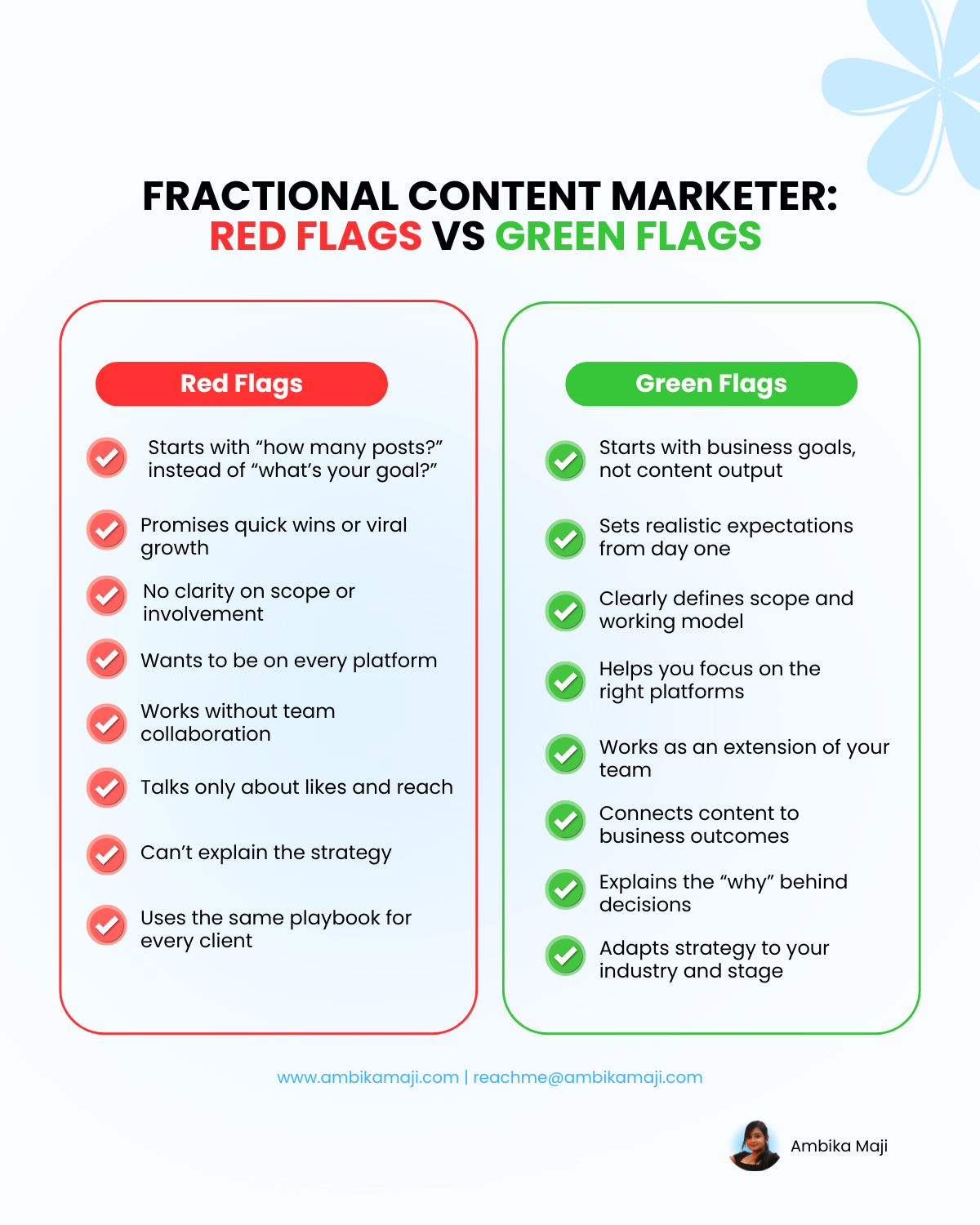
They don’t stop at reviewing your content. They dig into your business model, sales cycle, ICP, and goals. If the conversation starts with “How many posts do you need per month?”, take it as a red flag.
Prioritise direction over deliverables
Before jumping into execution, they define positioning, content themes, and priorities. Because without clarity, consistency alone won’t drive results.
Tell you what not to do
In early stages, doing fewer things well matters more.If someone agrees to every platform or trend, they’re likely not thinking strategically.
Integrate with your team
They work as an extension of your team, not just an external executor. This shows up in how they collaborate, share context, and build feedback loops with you.
Tie content to business outcomes (not just metrics)
Likes and impressions are easy to report. A good fractional marketer will try to connect content with pipeline, conversations, hiring visibility, or brand recall, even if attribution isn’t perfect.
Set realistic expectations
Content takes time, especially in B2B or niche industries. If someone promises quick wins without understanding your starting point, they’re oversimplifying the process.
Where to Find B2B Fractional Content Marketers for Hire
You’ll find fractional content marketers across platforms, but the quality varies based on where you look.
Here are some of my recommendations:
Most B2B marketers are active here. Use filters to find professionals within your network and industry.
Many (including me) build their personal brand here and rely on inbound leads.
When reviewing profiles, don’t just look at content, check their actual work experience to see if it aligns with your industry. If it looks relevant, schedule a call. Most offer a free initial consultation.
Referral and founder communities
Strong candidates often come through referrals. If they’ve already worked with someone in your network, it adds credibility. Ask in your WhatsApp or Slack groups, you’ll often get honest feedback along with recommendations.
Freelance marketplaces
Platforms like Upwork and Fiverr can also work, but you’ll need to filter carefully.
Search using terms like “content strategist” instead of just “writer” to find profiles that go beyond execution. They often do fractional content work.
Startup agencies offering fractional support
Some newer agencies offer fractional-style services with a team backing execution. This can be useful, but long-term dedicated attention may be limited.
Once you shortlist someone, ask around about them in your network. A quick check can help you catch red flags early.
What Does the First 30–60–90 Days Look Like?
A good fractional content marketer keeps everything transparent, from plans and trackers to output and even hiccups.If you’re not from a marketing background, it’s natural to wonder what this actually looks like in practice.
While this can vary by industry and business stage, here’s a realistic view of how the first 30–60–90 days usually unfold:
| Timeline | Focus Area | What the Fractional Content Marketer Does | What You (Founder/Team) Need to Do | Expected Outcome |
|---|---|---|---|---|
| 0–30 Days | Clarity & Direction | Understand your product, ICP, and market Audit existing content (if any) Identify gaps in messaging and positioning Define content pillars and core themes Set up basic workflows and tools | Share product insights, past content, and sales conversations Clarify goals (leads, awareness, authority) Be available for initial discussions | Clear content direction, defined audience, and a structured plan to move forward |
| 30–60 Days | Execution & Testing | Start content creation (LinkedIn, blogs, etc.) Test different angles, formats, and messaging Build a repeatable content system Begin distribution and repurposing | Review and approve content Provide feedback based on conversations with prospects Stay consistent with inputs (insights, ideas) | Consistent content output, early signals on what’s working, and improved messaging clarity |
| 60–90 Days | Optimization & Traction | Double down on high-performing content types Refine messaging based on engagement and feedback Improve distribution strategy Start aligning content with lead generation or pipeline | Support with deeper insights, case studies, or proof points Align content with business priorities (sales, launches) | Stronger content performance, clearer positioning, and early traction (engagement, inbound interest) |
Don't expect instant results in B2B content marketing. If you do see them, it's usually because a foundation already exists.
The first 90 days are about building clarity, consistency, and direction.
What Kind of Content Does a Fractional Content Marketer Create
It’s common for first-time founders to copy what competitors are doing. If competitors are posting case studies, they want to do the same.
But this doesn’t work like that.
The content your brand needs and what a fractional content marketer creates depends on your business model and what’s working in your industry.
From what I’ve seen across B2B startups, these formats tend to work well:
- Thought-led content that builds authority
- Problem-led content that attracts the right audience
- Case-style content that builds trust
- SEO-driven content that captures intent
- Conversion-focused content that supports sales
The mistake most teams make is relying on just 1–2 of these, usually the same ones their competitors are already doing.
For example, I’ve seen new brands with recently hired experienced teams (15+ years) jump straight into leadership content. The problem is, they don’t yet have proof of outcomes as a company. Those achievements belong to the team’s past roles, not the current brand.
In such cases, it works better to start with SEO-driven and problem-led content to attract the right audience.
Once there’s traction, you can move towards conversion-focused content. And after getting a few clients, thought-led and case-style content starts making more sense.
The point is simple. Don’t try to position yourself ahead of where you are.
Share what you genuinely know, avoid over-claiming, and don’t push too hard. Content that stays true to reality builds trust. Anything forced or exaggerated does the opposite.
What Results Are Realistic (And What Aren’t)
B2B marketing is a patience game. If it works, the payoff is strong, but no playbook delivers fast + organic results.
If you’re not from a marketing background, it’s important to know this: virality is not something any marketer can promise in B2B content. When you work with a content marketer, whether in-house or outsourced, expectations need to be grounded.
I still remember a client from my agency days who paid for social media organic content in the morning and expected to go viral by night. That’s not how it works.
If immediate reach is the goal, it usually requires paid ads alongside organic efforts.
That said, here’s what you can realistically expect from your content marketing efforts:
| Area | What You Can Realistically Expect | What You Shouldn’t Expect |
|---|---|---|
| Strategy & Clarity | Clear ICP, sharper messaging, defined content pillars | “We’ll figure it out as we go” or instant perfect positioning |
| Content Output | Consistent, structured content aligned with goals | Random viral posts without a system |
| Engagement | Gradual increase in likes, comments, and profile visits | High reach or virality on every post |
| Audience Building | Slow but relevant audience growth (right people, not just more people) | Rapid follower growth with high-quality leads |
| Inbound Interest | Early-stage conversations, DMs, or curiosity from prospects | Immediate, high-intent inbound leads ready to buy |
| Lead Generation | Occasional inbound leads after consistency builds | Predictable lead flow in the first few months |
| ROI & Attribution | Better visibility into what content works and supports sales | Direct, instant ROI attribution from individual posts |
| Team Alignment | Improved clarity between marketing, sales, and the founder’s messaging | Zero involvement required from the founder or team |
That said, from what I’ve seen, it usually takes at least 6–8 months to see some positive traction. There’s no overnight playbook.
It’s something you build consistently over time, especially as you train the algorithm.
For example, I recently started working on my Instagram side hustle. I wasn’t spending too much time on it as I have my content marketing biz too, but I stayed consistent. It took me almost a year to see real traction.
Over time, my average engagement reached around 1,500 views and 100 comments per post. The focus was never just views, but meaningful engagement and eventually lead generation.
It also took me a year to get my first order through an affiliate link. And this is just a side project.
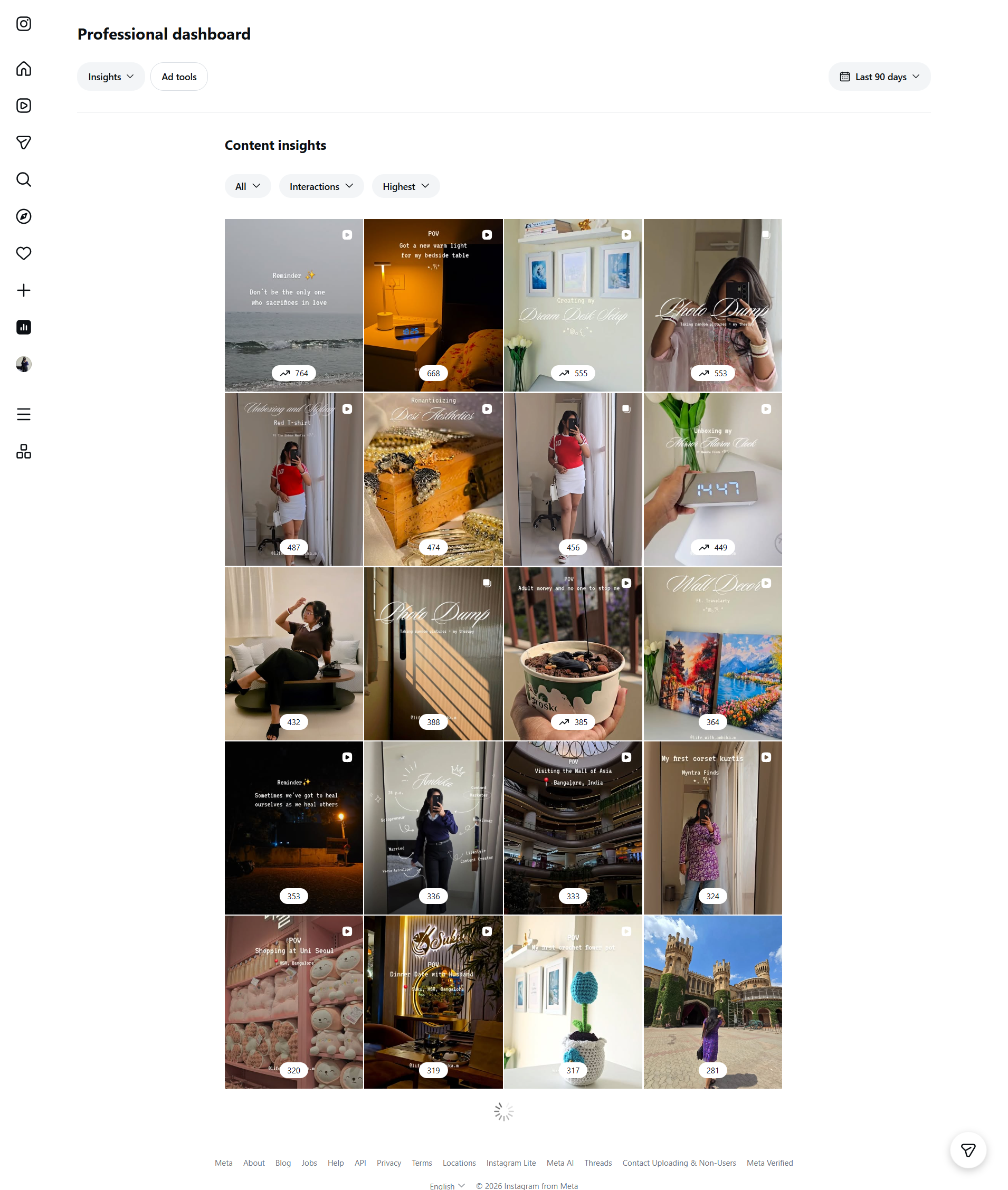
I’ve used ads as well, but only for small experiments to get extra traction. What actually led to a purchase was a post I never boosted. It worked purely because of the content quality and consistency over time.
While building my Instagram page, I went through a lot of trial and error. It’s not a large account, but it’s enough to validate what works when you’re starting.
That said, Instagram isn’t the strongest channel for B2B.
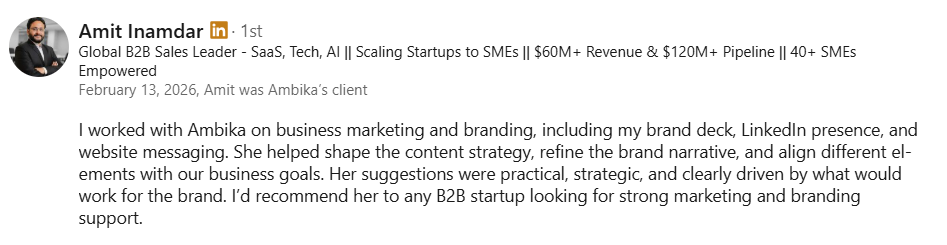
On the B2B side, I’ve closed a client purely through LinkedIn organic content. Out of 4-5 inbound calls in 3-4 months, one converted, with zero ad spend.
The client had been following my content for a while before reaching out for their new business.
One of my acquaintances, who has been running her marketing agency for 2+ years, is getting around 5–6 lead calls a month, mostly through LinkedIn.
She has outsourced her LinkedIn content to a LinkedIn expert, spending about ₹12–15k per month, and consistently managed 5–6 calls monthly, with some conversions. Along with this, she also handles other content activities herself and outsources a few.
I know this closely because we worked together on projects she closed through those calls.
So if you think LinkedIn content or any other content activity can be handled entirely by AI, or that one post a week is enough, it’s rarely the case.
How Will Content Tie Back to Revenue?
Fractional content support seldom drives revenue directly. It’s not sales, it supports sales.
For B2B startups and small businesses, content is used to build an audience that can turn into future leads. It shapes how people perceive your product and expertise, which eventually influences conversions.
When your audience consistently sees strategic content, they become familiar with your brand. This shortens the sales cycle.
By the time someone reaches out, they already understand what you offer and how it helps them.
If you expect a fractional content marketer alone to generate leads and conversions in isolation, it won’t work, or it will be slow.B2B content needs to work alongside sales. It’s a core part of the sales funnel, not a separate function.
In simple terms, your investment in content makes selling easier, which is what ultimately drives revenue.
From what I’ve seen, sales teams aren’t primarily responsible for generating inbound leads. They may bring some through outreach or networks, but that’s not their main role. That’s where content comes in.
Its job is to attract and warm up the right audience so that sales can convert them more effectively.
What Happens If It Doesn’t Work
When content doesn’t work, it hardly ever means “content marketing failed.” It’s usually because something underneath wasn’t clear.
Sometimes the messaging is too broad. Sometimes the audience isn’t well-defined. And often, expectations are unrealistic, expecting leads before building any visibility or trust.
There are also operational gaps:
- Inconsistent execution
- Lack of founder input
- No clear ownership
From what I’ve seen, most setups don’t need a complete reset. They improve when you:
- Narrow the audience
- Refine the message
- Change formats or distribution
- Align sales and content better
Content works best as an iterative process, not a one-time strategy. So, you need to ensure these are fixed before investing in a fractional content marketer. If not, you’ll get unsatisfactory results.
For example, I worked with a client between 2024 and 2025 across B2C and B2B. She handed over the entire content function to me but expected virality within 3–4 weeks. I had to repeatedly explain that it doesn’t work like that.
There’s no shortcut or “magic wand” to make content deliver overnight. To her credit, she eventually understood the process. But there was still little to no input from her side.
And that’s where things started breaking.
Content doesn’t work in isolation. It needs collaboration. Without founder or team input, it becomes generic.
I continued executing, but without context or direction, the content lacked depth.I could have kept going as many setups do, pushing out high volumes of generic content.But I knew it wouldn’t lead to meaningful results. So I stepped away.
She later hired an agency that matched her expectation, high output, low strategy.
Did it work? No.
The content was consistent, but there was no engagement or ROI.
This is something I’ve seen often. If a fractional marketer focuses only on quantity and sticking to a calendar, using generic or AI-led content without a strategy, it won’t work.
Yes, these services are cheaper. But they’re cheaper because there’s little thinking involved, just execution.
Many startups choose this because it fits the budget, only to drop content marketing altogether later, feeling like the investment went nowhere.
Can a Fractional Content Marketer Actually Help Your Business?
Yes, if you need direction, not just execution.
A fractional content marketer doesn’t just create content. They help you decide what to say, who to say it to, and how it supports your business goals. That’s often the missing layer in early-stage teams.
A fractional content marketer can also help you generate 3x more leads than traditional marketing at 62% lower cost .But those outcomes depend on having a clear strategy behind the content.
So, a fractional hire can truly help your business when:
- You don’t need a full-time hire yet
- Your content lacks direction or consistency
- You want content to support long-term growth
It won’t work if you’re expecting instant results or complete hands-off execution.
If you’re considering a fractional content marketer, let’s talk. Book a 1:1 consultation call or drop your requirement at reachme@ambikamaji.com
Note: Parts of this page are AI-assisted and have been reviewed and edited by me.
About the author

Ambika Maji
Ambika Maji is a freelance B2B content marketer with 8+ years of experience from India. Previously, she lived the corporate girlie life as a content marketer, helping B2B companies improve their content game. She specializes in SEO content, B2B content strategy, and social media content. As a writer, she specializes in data-backed blogs around content marketing, SEO, AI content, MarTech, and productivity. Off work, she enjoys reading books on Hindu Mythology and exploring Vedic astrology.